DIR-3 KYC last date: director KYC filing and DIN reactivation
Director KYC stopped being an annual filing on 31 March 2026. Every individual holding a DIN now files Form DIR-3 KYC Web on or before 30 June of the financial year immediately following every third consecutive financial year (Rule 12A). Filing inside the window costs nothing. A lapsed DIN costs ₹5,000 and blocks every MCA form you sign.
Contact the office →What is the DIR-3 KYC last date, and who has to file?
Every individual who holds a Director Identification Number (DIN) as on 31 March of a financial year must file Form DIR-3 KYC Web on or before 30 June of the financial year immediately following every third consecutive financial year. That is Rule 12A of the Companies (Appointment and Qualification of Directors) Rules, 2014, as substituted by MCA notification G.S.R. 943(E) dated 31 December 2025, in force from 31 March 2026. The obligation attaches to the DIN, not to holding office: if you hold a DIN and have never joined a board, or resigned from every board years ago, you still file. Filing inside the window is free. Filing late, or filing to reactivate a DIN that has already been deactivated, costs ₹5,000.
- ✓ Rule: Rule 12A, Directors Rules 2014
- ✓ Form: DIR-3 KYC Web (the only form)
- ✓ Frequency: triennial
- ✓ Deadline: 30 June of the financial year immediately following every third consecutive financial year
- ✓ On time: nil fee
- ✓ Late or reactivation: ₹5,000

Two notifications rewrote director KYC in 2026
The frequency, the deadline and the form all changed, and they changed in two separate instruments four months apart. Most published guidance has picked up one and missed the other.
- G.S.R. 943(E) dated 31 December 2025 — the Companies (Appointment and Qualification of Directors) Amendment Rules, 2025 — substituted Rule 12A. Brought into force 31 March 2026.
- G.S.R. 300(E) dated 21 April 2026 — the Companies (Registration Offices and Fees) Amendment Rules, 2026 — substituted the corresponding fee entries in the Table of Fees.
| Item | Up to FY 2024-25 | From 31 March 2026 |
|---|---|---|
| Frequency | Every financial year | Triennial |
| Deadline | 30 September | On or before 30 June of the financial year immediately following every third consecutive financial year (Rule 12A) |
| Form | e-form DIR-3 KYC for a first filing or where particulars had changed; the web service DIR-3 KYC-WEB where nothing had changed | Form DIR-3 KYC Web only. The two were merged and Rule 11 was consequentially amended |
| Fee, filed on time | Nil | Nil |
| Fee, filed late or to reactivate a DIN | ₹5,000 | ₹5,000 |
| Fee to record a change of mobile, e-mail or address | ₹500 | ₹500 |
The two-form distinction no longer exists
The rule of thumb almost every guide still repeats — "file the full e-form if something has changed, use the web service if nothing has" — describes a structure that was withdrawn. There is one form. What survived the merger is the verification burden, which now switches on what you are filing for rather than on which form you pick: a routine confirmation is completed by one-time password, while an update or a reactivation needs a digital signature and a professional certificate. Both are set out under which route applies to you.
One trade report published in April 2026 still described director KYC as an annual requirement. The gazette text of G.S.R. 943(E) and MCA's press release of 1 January 2026 both provide for a three-year cycle, and that is the position taken here.
Who must file — including the people who assume they need not
Rule 12A is drafted by reference to holding a DIN as on 31 March. It says nothing about being on a board, about the company being active, or about the DIN being used for anything. That drafting is why the largest group of defaulters is people who stopped thinking about the MCA years ago.
| Your position | Does DIR-3 KYC Web apply? |
|---|---|
| Director of an operating company | Yes |
| Director of a dormant company, or of a company that has filed nothing for years | Yes. The company's filing status is irrelevant to your personal obligation |
| You resigned from every board and hold no office anywhere | Yes, for as long as the DIN exists and has not been surrendered or cancelled under Rule 11 |
| You obtained a DIN for a company that was never incorporated, or you were named a proposed director and never took office | Yes. This is the group most often caught out |
| Designated partner of an LLP holding a DIN (the identifier formerly issued as a DPIN) | Yes. The two identifiers were unified; a designated partner holds a DIN and is within Rule 12A |
| Disqualified under section 164(2) | Yes. Disqualification does not cancel the DIN, and Rule 12A is written by reference to holding one |
| DIN already deactivated for non-filing | Yes — the same form, with the ₹5,000 fee, is the reactivation route |
| DIN surrendered on Form DIR-5, or cancelled by the Central Government under Rule 11 | No. There is no DIN to which the obligation can attach |
The forgotten DIN
A DIN is allotted to a person, not to a company, and it outlives the reason it was taken. The people who discover a deactivated DIN years later are almost always one of three: a promoter who took a DIN through SPICe+ for a venture that never got incorporated; a family member added as the second director of a private limited company to meet the two-director minimum, who has never signed anything since; or a director who resigned properly, had the DIR-12 for the resignation filed, and assumed that closed the file. Resignation ends the office. It does not end the DIN.
The discovery moment is rarely convenient — an invitation to join a new board, a lender asking for a guarantee from a director whose DIN turns out not to be live, or a family company's annual filings that cannot be signed because the other director's DIN is dead.
Designated partners deserve a separate mention because LLP compliance is often run apart from company compliance. Since the DIN and DPIN were unified, a designated partner of an LLP holds a DIN, and deactivation stops that person signing Form 11, Form 8 or any change filing just as surely as it stops a company director.
When your next filing actually falls due
Nothing falls due on 30 June 2026 or 30 September 2026 under the substituted rule. The next periodic window for the bulk of existing DIN holders opens in April 2028 and closes on 30 June 2028, the date MCA itself has given. For a DIN allotted after 31 March 2025 the first date has to be counted from the words of the rule, and the count is shown below.
| When your DIN was allotted | Next periodic filing, and its basis |
|---|---|
| On or before 31 March 2025, with DIR-3 KYC completed by 1 January 2026 (the last annual round under the old rule fell due on 30 September 2025) | April 2028 – 30 June 2028. This is MCA's own statement, in PIB release 2210552 of 1 January 2026 |
| During FY 2025-26 (1 April 2025 to 31 March 2026) | 30 June 2028 on this page's reading of the rule. The DIN is held as on 31 March 2026, the same test the older DINs meet. Counting FY 2025-26, 2026-27 and 2027-28 as the three consecutive financial years, the immediately following year is FY 2028-29, and its 30 June is 30 June 2028. Some published commentary starts the count a year later and gives 30 June 2029. Neither the rule nor the PIB release deals with this case expressly |
| During FY 2026-27 (1 April 2026 to 31 March 2027) | 30 June 2029 on the same count. The DIN is first held on 31 March 2027; FY 2026-27, 2027-28 and 2028-29 are the three years, and the immediately following year is FY 2029-30, so the date is 30 June 2029. Commentary that starts the count a year later gives 30 June 2030 |
Where these dates come from, stated plainly. The rule is G.S.R. 943(E) dated 31 December 2025, as published in the Gazette of India (Extraordinary) of 31 December 2025. The substituted Rule 12A(1) requires every individual who holds a DIN as on 31 March of a financial year to file Form DIR-3 KYC Web "on or before the 30th June of the immediately following every third consecutive financial year". The notification has no transitional proviso, and it does not say from which financial year the three are counted. The 30 June 2028 date in the first row is MCA's: PIB release 2210552 of 1 January 2026 states that all directors who have completed their KYC till date are covered by the new provisions and that their next KYC filing is due by 30 June 2028. The second and third rows are this page's count of the rule's words, not an MCA statement.
So: diarise 30 June 2028 for a DIN allotted on or before 31 March 2025; for a later DIN, diarise the earlier of the two dates in its row, and confirm your own DIN's allotment date and status on the MCA portal before relying on it. An unnecessary early filing costs nothing; a missed one costs ₹5,000 and a dead DIN. Note too that a DIN allotted on 2 April sits outside that financial year's population entirely, because the test is holding a DIN as on 31 March. Our MCA compliance calendar shows where this window sits against AOC-4, MGT-7 and the event-based forms.
One form, two very different filings
The merged form behaves differently depending on why you are filing. Route A is a confirmation that nothing has changed and needs no signature and no professional. Route B is anything else, and needs both.
| Dimension | Route A — periodic confirmation | Route B — update or reactivation |
|---|---|---|
| When it applies | Your three-year window is open and none of your recorded particulars have changed | You are recording a change of mobile number, e-mail or residential address, or you are reactivating a deactivated DIN, or you are filing after the due date |
| Verification | Separate one-time passwords to your registered mobile number and registered e-mail address, both entered within their validity | The same OTP verification, plus the two items below |
| Digital signature of the DIN holder | Not required | Required |
| Certification by a professional in practice | Not required | Required — a Chartered Accountant, Company Secretary or Cost Accountant in whole-time practice |
| Government fee | Nil, inside the window | ₹500 for a change of particulars; ₹5,000 late or on reactivation |
What the OTP step really tests
It tests whether the contact details on your DIN record are still yours. Both passwords are sent separately and both must be entered. That is trivial for a director whose number has not changed in ten years and impassable for one whose registered e-mail is a mailbox at a consultant's office that closed. In the second case the filing cannot complete as Route A at all: you have to update the details, which converts it into a Route B filing with a signature, a certificate and a ₹500 fee. Checking that the recorded number and address still reach you — before the window opens, not during it — is the cheapest thing on this page.
The digital signature, and why it fails
Route B filings are signed with the DIN holder's own digital signature certificate, and two failure modes account for most of the trouble. Either the certificate has expired, so a fresh DSC has to be issued before anything else happens; or it is perfectly valid but has never been associated with the individual's user profile on the MCA V3 portal. V3 association is separate from whatever was done on the old V2 portal and has to be redone. A valid but unassociated DSC produces an upload failure that reads like a form error and sends people hunting in the wrong place.
What the form asks for
Nationality and citizenship, date of birth, permanent account number for Indian nationals, passport details for foreign nationals, permanent and present residential address with country codes, and personal mobile number and e-mail address. A Route B filing attaches self-attested proof of identity and address. A Route A confirmation generally asks for nothing beyond the OTP verification — the form is pre-populated from the DIN record and you are confirming it, not rebuilding it.
Filing DIR-3 KYC Web on the MCA V3 portal, step by step
- Log in to the MCA portal with the DIN holder’s own user ID, as a registered user.
- Open the DIR-3 KYC Web service and enter the DIN. The form is pre-filled from the DIN record: name, date of birth, PAN, mobile number and e-mail address.
- Check every pre-filled detail. If nothing has changed, this is Route A.
- Request the one-time passwords sent separately to the registered mobile number and e-mail address, and enter both within their validity.
- Route A: submit. Route B (a change of details, a late filing or a reactivation): update the details, attach the self-attested proofs, sign with the DIN holder’s own digital signature, have a professional in practice certify it, and pay the fee.
- Keep the acknowledgement with the SRN; it is the only evidence the filing was made inside the window.
What it costs — and what it does not cost
The fee entries were substituted by the Companies (Registration Offices and Fees) Amendment Rules, 2026, G.S.R. 300(E) dated 21 April 2026. These are Ministry fees payable on the portal. No professional charges are stated on this site.
| Filing | Fee |
|---|---|
| Form DIR-3 KYC Web filed on or before 30 June of the financial year immediately following every third consecutive financial year (Rule 12A) | Nil |
| Filed after that timeline | ₹5,000 |
| Filed for reactivation of a DIN | ₹5,000 |
| Filed again at any time to record a change of mobile number, e-mail address or residential address | ₹500 per filing |
Sources differ on whether G.S.R. 300(E) took effect on 21 or 22 April 2026. The fee amounts themselves are not in dispute. The binding figure at the moment of filing is always the one computed by the MCA fee enquiry service, and that is what should be quoted to anyone budgeting for a filing.
The ₹5,000 is a flat fee, not a daily accrual. The distinction matters because the two regimes people confuse it with behave differently: ordinary e-forms attract multiples of the normal fee escalating from two times to twelve times with the length of delay, and the annual filings under sections 92 and 137 attract ₹100 per day with no cap at all. Director KYC is neither. A DIN deactivated three years ago costs the same ₹5,000 to restore as one deactivated last month. The damage from delay is not financial — it is everything the DIN cannot do while it is dead. The full MCA fee schedule sets the regimes side by side.
What a deactivated DIN actually stops
Where the filing is not made, MCA21 marks the DIN "Deactivated due to non-filing of DIR-3 KYC". Nobody writes to tell you. The status simply changes, and the consequences surface the next time that DIN is needed for anything.
A DIN is the credential that authenticates a director on the MCA portal. Deactivate it and the individual cannot sign or authenticate any e-form with it:
- The company's AOC-4 and MGT-7 / MGT-7A cannot be signed by that director.
- DIR-12 for any appointment, resignation or change in designation cannot be authenticated by them.
- INC-22, PAS-3, SH-7 and the rest of the event-based set are blocked to the extent that director is the signatory.
- The person cannot be named as a director in a SPICe+ incorporation, so a new company incorporation stalls if they are one of the proposed directors.
- They cannot be appointed to any new board while the DIN is inactive.
The company's deadlines do not pause while this is sorted out. If the annual filings slip because the signatory's DIN is dead, the company accrues the section 403 additional fee of ₹100 per day, per form, with no ceiling — and it runs on AOC-4 and MGT-7 independently, so a company in default on both accrues ₹200 a day. Our page on annual ROC filings in Nagpur works through that arithmetic.
There is a step change at the three-year mark that turns an administrative nuisance into a five-year problem. Where a company has not filed financial statements or annual returns for three continuous financial years, every person who is or has been a director of it is disqualified under section 164(2)(a) for five years. The proviso to section 167(1)(a) then vacates that person's office in every other company but not in the defaulting one — so they cannot resign their way out of the company that caused it, while being simultaneously off boards elsewhere, often with no board resolution having been passed.
Deactivation is not disqualification
Two separate conditions, two separate cures, and conflating them wastes money. Deactivation for non-filing of KYC is an administrative status under the Directors Rules: one filing and ₹5,000 and the DIN comes back. Disqualification under section 164(2) is a statutory consequence of a company's filing default; it runs five years and is not cured by paying anything. A DIN can be deactivated without the holder being disqualified, and a disqualified director's DIN can be perfectly current. Establish which you are looking at before spending anything — the MCA record will tell you.
How to reactivate a deactivated DIN
There is no separate reactivation form and no application for restoration. Reactivation is Form DIR-3 KYC Web filed with the ₹5,000 fee, as a Route B filing. The work is almost entirely in the preparation.
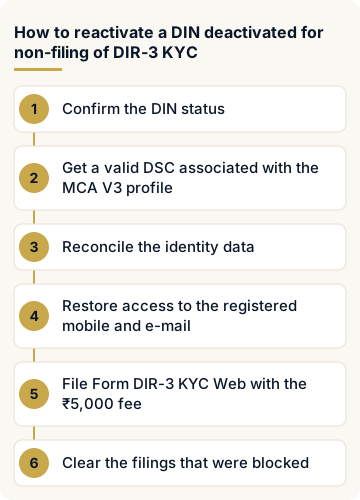
- Confirm what the status actually says. "Deactivated due to non-filing of DIR-3 KYC" is a different condition from "Disqualified u/s 164(2)" and from a DIN cancelled by the Central Government under Rule 11 for duplication, fraud, death, unsoundness of mind or insolvency. Only the first is cured by this filing.
- Put a working digital signature in place. The DIN holder signs personally. Check the certificate has not expired and is associated with that individual's MCA V3 user profile. If a new certificate is needed, that step controls the timetable, not the filing.
- Reconcile the identity data before you open the form. Name, date of birth and PAN as entered must reconcile with the records they are validated against. A middle name on the DIN record but absent from the PAN, or a date of birth typed differently at the time of the original DIN application, stops most reactivations. Where the DIN record itself is wrong, correcting it is a separate exercise that has to happen first.
- Restore access to the registered mobile and e-mail, or replace them in the same filing. Both are verified by one-time password. If the recorded address belongs to a former accountant or an abandoned domain, update it here rather than discovering the problem at the OTP screen.
- File Form DIR-3 KYC Web with the ₹5,000 fee, digitally signed by the DIN holder and certified by a Chartered Accountant, Company Secretary or Cost Accountant in practice.
- Then clear what was stuck behind it. Reactivation restores the credential; it files nothing else. Annual filings, board changes and any waiting event-based form still have to be dealt with, and the additional fee on those has been running throughout.
An honest timetable. Where the signature is in hand, the data reconciles and the registered contact details still work, this is a same-day filing. Where a new DSC has to be issued, DSC issuance drives the schedule. Where the registered e-mail belongs to someone you have lost touch with, or the DIN record carries a name or date of birth that does not match the PAN, allow weeks rather than days — and those weeks are spent before the form is opened. MCA publishes no service standard for the status change after filing, so build a buffer if reactivation is on the critical path for another deadline.
When your mobile number, e-mail or address changes
A change in your registered mobile number, e-mail address or residential address must be intimated by filing Form DIR-3 KYC Web again within 30 days of the change, with a fee of ₹500. That is Rule 12A(2), and it applies whether or not your three-year window is open.
This is the obligation people breach without realising there was one. Changing a phone number is not an MCA event in anybody's mental model of compliance, and there is no prompt and no immediate consequence. The consequence arrives later, at the OTP screen of the periodic filing, when the number on record no longer belongs to you.
The trap worth naming: a mid-cycle update does not restart the three-year clock. Filing DIR-3 KYC Web in 2027 to record a new e-mail address does not discharge the periodic obligation and does not move your next window. They are separate obligations that happen to share a form. Anyone reasoning "I filed last year, so I am covered" has misread the structure.
A change filing is a Route B filing, so it carries the digital signature and certification requirements as well as the ₹500. Keeping the recorded details current as they change is cheaper than letting all three drift and settling up in one filing later.
Foreign directors, and directors without an Indian mobile number
A foreign national holding a DIN is inside Rule 12A on the same terms as anyone else. What differs is the evidence: passport details are mandatory for a foreign national, where for an Indian national the permanent account number carries that weight, and residential addresses are recorded with country codes, so an overseas address is expected rather than exceptional. Published guidance indicates a foreign mobile number is given where the director is outside India and an Indian number where they are in India — that is guidance on which number to record, not a statement of what the form will validate, and we have not confirmed the validation behaviour. Confirm it before planning around it.
The real constraints for a non-resident sit upstream of the filing. One-time passwords have to reach a number and a mailbox the director can access at the moment of filing, across time zones. A digital signature certificate for a foreign national is issued on identity documents that generally have to be notarised and apostilled, or consularised where the country is not party to the Hague Convention — weeks, not days, and finished before a Route B filing can begin. For a director abroad whose DIN is already deactivated, the DSC is the schedule.
One point for the company rather than the director: if a non-resident signs your annual filings or a change in the board, their KYC status is your deadline risk too. Checking it belongs in the same review as the AGM date.
Why you cannot simply surrender a DIN to avoid this
Rule 11 of the same Rules governs cancellation, surrender and deactivation of a DIN, and voluntary surrender on Form DIR-5 is available on a narrow footing. The applicant must declare that they have never been appointed as a director in any company and that the DIN has never been used for filing any document with any authority. The Central Government verifies the electronic records before acting on it.
Read that against the population it is meant to help. It works for exactly one person: the individual who took a DIN for a venture that never incorporated and never signed a thing. It does not work for a retired director, because they held office. It does not work for someone whose DIN appears on a single DIR-12 from 2019, because the DIN has been used. And it does not work as a response to a deactivation — surrender is not an amnesty and the rule is not drafted to provide one.
Rule 11 also lets the Central Government cancel or deactivate a DIN where it is a duplicate, where it was obtained wrongfully or fraudulently, or on the holder's death, unsoundness of mind or adjudication as insolvent. None is a voluntary route out. The Table of Fees puts the DIR-5 application at ₹1,000; that figure rests on a single reproduction of the Annexure, so confirm it on the MCA fee enquiry service before budgeting for it.
The conclusion is unglamorous: if you hold a DIN, the obligation follows you until the DIN is validly cancelled, and for almost everyone the cheapest available position is the nil-fee filing made inside the window.
Where this goes wrong in practice
- The registered e-mail belongs to somebody else. A consultant's mailbox, a former employer's domain, a shared office address. The OTP lands somewhere unreachable and a filing that should have been free becomes a certified filing with a fee.
- The DSC is valid on paper but not associated with the V3 profile. The failure appears at upload and reads like a form defect, sending people back into the data instead of into the profile settings.
- Name and date of birth do not reconcile. DIN records created a decade ago often carry a fuller or shorter name than the PAN, or a date of birth in a different format. That is fixed on the record, not worked around in the form.
- Everyone assumes the company handles it. The obligation is personal to the DIN holder. A company secretary can prepare and certify the filing, but the company has no statutory duty to make it and no exposure if it is missed. The director does.
- "I resigned, so it does not apply to me." The most expensive misreading on this page. Resignation ends the office; the DIN survives it, and so does Rule 12A.
- Diarising 30 September. Still published widely enough to keep catching people for years. The date is 30 June.
DIR-3 KYC — frequently asked questions
What is the difference between DIR-3 KYC and DIR-3 KYC Web?
Until 31 March 2026 there were two forms: the e-form DIR-3 KYC, signed with a digital signature and certified by a professional, and the OTP-based DIR-3 KYC Web for confirming details already on record. G.S.R. 943(E) merged them, so DIR-3 KYC Web is now the only form. It runs as a simple OTP confirmation when nothing has changed, and with a digital signature, a professional’s certificate and a fee when details change, the filing is late or a DIN is being reactivated.
What is the DIR-3 KYC last date or due date?
There is no annual last date any more. Under Rule 12A, as substituted by G.S.R. 943(E) dated 31 December 2025 and in force from 31 March 2026, DIR-3 KYC Web is due on or before 30 June of the financial year immediately following every third consecutive financial year. A director whose KYC was done by 1 January 2026 next files by 30 June 2028. Nothing falls due on 30 June or 30 September 2026. Filing inside the window is free; filing late, or to reactivate a deactivated DIN, costs ₹5,000.
Is DIR-3 KYC annual or once every three years?
Triennial, not annual. Rule 12A of the Companies (Appointment and Qualification of Directors) Rules, 2014 was substituted by G.S.R. 943(E) dated 31 December 2025, in force from 31 March 2026, and now requires Form DIR-3 KYC Web on or before 30 June of the financial year immediately following every third consecutive financial year. The annual 30 September deadline applied up to FY 2024-25 and is spent.
Is anything due on 30 June 2026 or 30 September 2026?
No periodic director KYC falls due on either date under the substituted rule. The two obligations that can arise in the meantime are the 30-day intimation of a change in your registered mobile number, e-mail or residential address, at ₹500, and reactivation of a DIN already deactivated, at ₹5,000.
I hold a DIN but I am not a director of any company. Do I still have to file?
Yes. Rule 12A attaches the obligation to every individual holding a DIN as on 31 March of a financial year, not to holding office. A DIN taken for a company that was never incorporated, or retained after resigning from every board, still carries the filing obligation until the DIN is surrendered or cancelled under Rule 11.
What does it cost if I am late?
₹5,000. Under the Companies (Registration Offices and Fees) Amendment Rules, 2026, G.S.R. 300(E) dated 21 April 2026, filing on or before the due date is free; filing after it, or filing to reactivate a DIN, carries a flat fee of ₹5,000. It is a flat fee, not a daily accrual.
My DIN says "Deactivated due to non-filing of DIR-3 KYC". What do I do?
File Form DIR-3 KYC Web with the ₹5,000 fee. That filing is the reactivation route. It must be digitally signed by the DIN holder and certified by a Chartered Accountant, Company Secretary or Cost Accountant in practice, so a valid DSC associated with your MCA V3 profile has to be in place first.
Do I need a digital signature and a professional to certify the form?
Not for a periodic filing where nothing has changed — that is completed by one-time password verification of your registered mobile number and e-mail address, with no DSC and no professional certification. A DSC and certification by a practising CA, CS or CMA are required where you are updating particulars or reactivating a deactivated DIN.
Sources & further reading
- Ministry of Corporate Affairs — the MCA21 V3 portal, where Form DIR-3 KYC Web is filed and where a DIN's current status and allotment date can be checked.
- MCA notifications index — G.S.R. 943(E) dated 31 December 2025 (substituting Rule 12A, in force 31 March 2026) and G.S.R. 300(E) dated 21 April 2026 (the DIR-3 KYC fee entries).
- MCA fee enquiry service — computes the fee actually payable on a form at the moment of filing. This is the binding figure, not any published table.
- India Code — the Companies Act, 2013 and the rules made under it, including the Companies (Appointment and Qualification of Directors) Rules, 2014 and the Companies (Registration Offices and Fees) Rules, 2014.
- The Gazette of India — where G.S.R. notifications are published in their authentic form. G.S.R. 943(E) is at egazette.gov.in/WriteReadData/2025/268970.pdf.
- Press Information Bureau, release 2210552 — Ministry of Corporate Affairs, 1 January 2026, on the move from annual to three-yearly director KYC, including the next due date of 30 June 2028 for directors who had completed KYC.
- Institute of Company Secretaries of India — the professional body regulating Company Secretaries in practice, who may certify Route B filings.
Statutory positions stated on this page are current as at 25 October 2026. Fees, forms and deadlines change; confirm the current position before acting. Two points on this page are expressly flagged as unsettled — the first three-year cycle for a DIN allotted after 31 March 2025, and the effective date of G.S.R. 300(E) — and should be checked against the gazette text for anything consequential.
Contact details
A DIN's status is shown on the MCA portal; a deactivated DIN is restored by filing DIR-3 KYC Web with the ₹5,000 fee. Directions and full details are on the contact page.
Manewada, Nagpur – 440027
What we handle
- ✓ DIN status and cycle check
- ✓ Periodic DIR-3 KYC Web filing
- ✓ Change of mobile, e-mail or address
- ✓ Reactivation of a deactivated DIN
- ✓ Certification as a CS in practice
- ✓ DSC issuance and V3 association