How to restore a struck-off company under Section 252
Two routes, two limitation periods, two different legal tests — and the one you qualify for depends on who you are and how the company came off the register. Below: how to work out which applies, what evidence actually persuades the Tribunal, and the back-filing bill that arrives after the order.
Contact the office →How is a struck-off company brought back?
A company whose name has been struck off the register is restored only by order of the National Company Law Tribunal under section 252 of the Companies Act, 2013. There is no MCA form and no departmental route. Two limbs are available: an appeal under section 252(1) by any person aggrieved by the Registrar's order, filed within three years from the date of that order; or an application under section 252(3) by the company, or any member, creditor or workman, made before the expiry of twenty years from the publication in the Official Gazette of the notice under section 248(5). For a registered office anywhere in Maharashtra — Nagpur and the rest of Vidarbha included — the bench is NCLT Mumbai; there is no NCLT bench at Nagpur. On restoration, section 252(2) requires the company to file the order with the Registrar within thirty days, the Registrar issues a fresh certificate of incorporation, and every overdue annual filing must then be cleared at ₹100 per day, per form, uncapped.
- ✓ Forum: NCLT Mumbai (Maharashtra & Goa)
- ✓ Appeal window: 3 years from the ROC's order
- ✓ Application window: 20 years from Gazette publication
- ✓ Petition: Form NCLT-9, affidavit in NCLT-6
- ✓ After the order: INC-28 within 30 days
- ✓ Typical elapsed time: months, not weeks

First work out which situation you are in
Section 252 is not one remedy. It is three, with different applicants, different starting dates and different things the Tribunal has to be satisfied about. Getting this wrong is the most expensive mistake available on this page, because a missed limitation period cannot be repaired.
| Dimension | s.252(1) — appeal | Second proviso to s.252(1) | s.252(3) — application |
|---|---|---|---|
| Who may move | Any person aggrieved by the Registrar's order notifying the company as dissolved under s.248 | The Registrar itself | The company, or any member, creditor or workman |
| Clock starts | Date of the Registrar's order | Date of the order dissolving the company under s.248 | Date of publication in the Official Gazette of the notice under s.248(5) |
| Limitation | 3 years | 3 years | 20 years |
| What must be shown | That removal was not justified in view of the absence of any of the grounds on which the Registrar passed the order | That the name was struck off inadvertently, or on the basis of incorrect information furnished by the company or its directors | That the company was, at the time of striking off, carrying on business or in operation, or that it is otherwise just that the name be restored |
| Typical use | A third party with a stake in the company's existence who is not a member, creditor or workman | Rare — the Registrar correcting its own record | The ordinary route for directors, shareholders, banks, creditors and the Income-tax Department |
Three things this table settles that most guides blur
The two clocks start on different days. The three-year appeal runs from the date of the Registrar's order; the twenty-year application runs from publication in the Official Gazette of the notice under section 248(5). Anywhere near the three-year line, work to the earlier date.
The tests are different, and the s.252(1) test is narrower. Section 252(1) asks whether removal was justified given the grounds the Registrar acted on — an attack on the basis of the order. Section 252(3) asks something else: was the company carrying on business or in operation, or is restoration otherwise just. A case that fails as an appeal can succeed as an application, and the pleadings are not interchangeable.
Standing differs. Section 252(3) names four classes; section 252(1) is open to "any person aggrieved". A party with a real commercial interest who is none of those four — a contract counterparty, a purchaser dealing with company property, a guarantor — is on the three-year clock, not the twenty-year one. Check that before assuming twenty years of comfort.
If the ROC struck the company off on its own motion
This is the common case, and the appeal turns on the grounds the Registrar relied on. Section 248(1) lets the Registrar act suo motu where the company has failed to commence its business within one year of incorporation (clause a); where it has not been carrying on any business or operation for two immediately preceding financial years and has not applied for dormant status under section 455 (clause c); where the subscribers have not paid the subscription they undertook and no declaration under section 10A in Form INC-20A has been filed within 180 days of incorporation (clause d, inserted by the Companies (Amendment) Act, 2019 with effect from 2 November 2018); and where the company is not carrying on any business or operations as revealed after physical verification under section 12(9) (clause e). Lists that reproduce these as a tidy run of "(a) to (d)" are copying a superseded text — there is no live clause (b).
Under section 252(1) you are arguing about those grounds. If the order rested on clause (c), the answer is evidence that the company was carrying on business or operation in the two years concerned; if on clause (d), it is the subscription money and the INC-20A position. An appeal that does not engage with the ground the Registrar acted on is not an appeal.
If the company applied for strike-off itself and now regrets it
Harder, and the difficulty is one the company created. A voluntary strike-off under section 248(2) rests on a special resolution or the consent of 75% of members by paid-up capital after extinguishing all liabilities, a statement of accounts in Form STK-8 showing nil, an indemnity bond in Form STK-3 and an affidavit in Form STK-4 from every director. Asserting afterwards that the company was carrying on business contradicts its own sworn material.
What is left is the second limb of section 252(3): that it is otherwise just that the name be restored. That limb is used, but it needs a specific consequence of dissolution to undo — an immovable property or a fixed deposit standing in the company's name, a receivable only the company can sue for, a contract or licence that cannot be assigned, a liability that was not in fact extinguished. Say what the restoration is for; a petition that cannot answer that is asking the Tribunal to reverse the applicant's own decision for no stated purpose.
A creditor's twenty years cuts both ways. Section 248(2) is not a way to walk away from a debt. Section 248(7) keeps the liability of every director, officer and member alive as if the company had never been dissolved, section 248(8) preserves the Tribunal's winding-up power, and section 252(3) gives any creditor twenty years in which to bring the company back and pursue it. If you are being advised that a voluntary strike-off under section 248 closes a disputed liability, it does not — it defers it.
Check whether the company is actually struck off yet
A large share of the people who search for this have not been struck off. They have received a notice. The difference decides whether you need a tribunal or a filing clerk, and the gap between those two answers is several lakh rupees and several months.
| Stage | What it is | Are you dissolved? | What to do |
|---|---|---|---|
| STK-1 | Notice from the Registrar to the company and its directors, calling for representations | No | Reply, and regularise the filings. Section 252 is not in play |
| STK-5 / STK-6 | Public notice of the intended removal | No — but the window is closing | Object and file. Once the final notice issues, the options change entirely |
| STK-7 | Notice of striking off, published in the Official Gazette | Yes — the company stands dissolved | Section 252 is now the only route. Note the Gazette date — it starts the twenty years |
Two public records settle the question. The MCA21 master data for the CIN shows the company status — "Active", "Under process of striking off", "Strike Off". The Gazette of India carries the STK-7 notice, and its publication date fixes the twenty-year period under section 252(3). Pull both before anything is drafted; a petition that guesses at the strike-off date is one the registry will return.
If you are not dissolved yet, the cheapest revival is the one you never need
A company at the STK-1 stage does not need the Tribunal. It needs its overdue annual filings, made at the normal filing fee and the full additional fee. The Companies Compliance Facilitation Scheme, 2026, which cut that additional fee to 10%, closed on 15 September 2026: it opened on 15 April 2026 under MCA General Circular No. 01/2026 dated 24 February 2026 and was extended by General Circular No. 03/2026 dated 8 July 2026 and General Circular No. 04/2026 dated 31 August 2026. MCA's own FAQ example shows the difference: an annual return 300 days late attracts ₹30,000 of additional fee, against ₹3,000 under the scheme. The CCFS-2026 page sets out what its closure changed, and the MCA and ROC fee calculator computes the position for your own delay.
Limited liability partnerships are a different regime. Section 252 belongs to the Companies Act, 2013. An LLP struck off under section 75 of the Limited Liability Partnership Act, 2008 in Form 24 — processed by C-PACE for LLPs since 27 August 2024 — is not restored under section 252, and LLP forms were expressly outside CCFS-2026, so Form 8 and Form 11 arrears carry the full additional fee. Do not let a page about companies set your expectations for an LLP.
What the Tribunal actually weighs
Under section 252(3) the Tribunal must be satisfied that the company was, at the time of striking off, carrying on business or in operation. Restoration petitions are won and lost on documents from the years around the strike-off, not on the sincerity of the affidavit.
Note the disjunction: "carrying on business or in operation". Being in operation is wider than trading. A company that holds and maintains an immovable property, services a term loan, prosecutes or defends litigation, or maintains a licence can be in operation in a year in which it invoiced nothing. That distinction is what saves genuine holding and asset-owning companies, and it should be pleaded rather than left to inference.
| Evidence | What it establishes | What weakens it |
|---|---|---|
| Income-tax returns actually filed for the relevant years, with acknowledgements | The strongest single item. A filed return for the year of strike-off is an independent government record that the company was live | Nil returns filed only to keep the PAN alive; returns filed after the strike-off to build the case |
| Bank statements for the whole period | Operating movement — receipts from customers, payments to suppliers, salaries, statutory dues | Statements showing only bank charges, interest credits and a dormant balance. That is an open account, not an operating one |
| GST returns — GSTR-1 and GSTR-3B — and the registration status | Outward supply in the period, month by month, on a record the Tribunal can verify | Nil returns; a registration cancelled before the strike-off period |
| Sales and purchase invoices, e-way bills, delivery records | The trade behind the returns, in specifics | Invoices with no matching bank credit or GST return |
| Employee records — salary registers, PF and ESIC challans, Form 16 | A payroll running through the period is difficult to characterise as inactivity | A single director's remuneration entry with no payment trail |
| Property, leases, utility bills, contracts in the company's name | Both operation and the practical reason restoration is needed at all | A lease that expired before the period; bills in a director's personal name |
| Audited financial statements for the back years, signed, even though never filed with the ROC | That accounts existed and were adopted; it also shows the catch-up filings can actually be made | Accounts prepared for the petition, signed on a single recent date for five years at once |
Strong applicants and weak applicants
The petitions that succeed are brought by people with a concrete reason: a bank or creditor that needs a live company to sue or to enforce security; the Income-tax Department, which routinely applies to restore a company so an assessment can be completed; directors who need the company back to complete a property transaction or release a fixed deposit; and companies that were genuinely trading and were struck off in error.
The weak applicant is the one who wants a DIN reactivated. A director whose company was struck off suo motu after three financial years of non-filing is asking the Tribunal to find that the company was in operation during precisely the period in which it filed nothing. Three years of silence is evidence against that proposition, not for it. If there is nothing behind the petition but the inconvenience, the disqualification problem has a different answer.
Who turns up on the other side
The Registrar files a report — that is the point of serving it at least fourteen days before the hearing — setting out the filing history and any adjudication or prosecution on foot. The Income-tax Department is commonly given notice and objects where assessments or demands are pending, or occasionally supports restoration for its own recovery reasons. None of that is unusual. What causes problems is a petition that has not disclosed a pending proceeding which the ROC's report then discloses for it.
From petition to fresh certificate of incorporation
A tribunal process, run under the National Company Law Tribunal Rules, 2016. It is measured in months, and the drafting is the smallest part of the work.
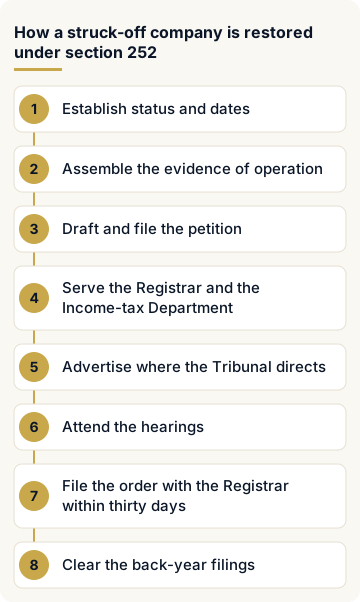
| # | Stage | Detail |
|---|---|---|
| 1 | Status and dates | MCA21 master data plus the Official Gazette notice. Fix the date of the Registrar's order and the date of Gazette publication |
| 2 | Evidence assembly | The documents in the table above, year by year. This is where the elapsed time actually goes — banks and departments do not produce five-year-old records quickly |
| 3 | Petition | Form NCLT-9, verified by affidavit in Form NCLT-6, filed at the bench with territorial jurisdiction, with the prescribed fee |
| 4 | Service | Copy served on the Registrar of Companies at least fourteen days before the date of hearing; notice to the Income-tax Department and to any other person the bench directs |
| 5 | Advertisement | Where the Tribunal directs publication of the petition, in the form and newspapers the order specifies. Take this from the order and the registry checklist, not from a precedent |
| 6 | Hearing | ROC report; objections, if any; typically two to four effective hearings. Section 252(1) requires a reasonable opportunity of making representations to the Registrar, the company and all persons concerned |
| 7 | Order | Restoration, with directions — customarily including the back-year filings and costs to the Registrar |
| 8 | INC-28 | Copy of the order filed with the Registrar within thirty days from the date of the order — section 252(2) |
| 9 | Fresh certificate | The Registrar restores the name and issues a fresh certificate of incorporation |
| 10 | Catch-up filings | Every overdue AOC-4, MGT-7 or MGT-7A and ADT-1, at full additional fee. See the next section |
The bench, and what that means from Nagpur
NCLT Mumbai's territorial jurisdiction is the State of Maharashtra and the State of Goa. A company registered in Nagpur, Wardha, Amravati, Chandrapur or any other Vidarbha or Marathwada district files at Mumbai. That is unaffected by the Registrar of Companies at Nagpur, which took effect on 16 February 2026 and covers eighteen districts — the ROC and the Tribunal are different institutions with different maps. There is no NCLT bench at Nagpur and no notified circuit sitting there.
The Amaravati trap. NCLT has a bench at Amaravati. That is Amaravati, the capital region of Andhra Pradesh — not Amravati district in Maharashtra. The spellings differ by one letter, so it is worth stating plainly: a company registered at Amravati in Maharashtra is a Mumbai bench matter, and so is a company registered at Wardha.
Fees, and the numbers not to trust
The Tribunal fee is modest. The Schedule of Fees to the NCLT Rules, 2016 is the authority; reproductions in circulation give ₹1,000 for an appeal or application under section 252, while some practitioner sources quote ₹2,500. Confirm the current entry before filing rather than budgeting off a blog. Separately, the Tribunal customarily directs the applicant to pay the Registrar's costs of and occasioned by the petition — an amount at the Tribunal's discretion, varying by bench and by facts. Figures of ₹25,000 and ₹50,000 circulate online as though they were a tariff. They are not, which is why no rupee figure appears here. Other statutory fees you will meet along the way are set out on the government fees page.
On elapsed time: at NCLT Mumbai, six to twelve months from filing to order is a typical planning assumption (not a statutory period or a commitment) for a straightforward, well-evidenced petition, and longer where the matter is part-heard across a bench reconstitution or the Income-tax Department contests. That is an experience-based range, not a published statistic. A restoration through the Tribunal is not completed in weeks.
The largest bill arrives after you have won
Restoration puts the name back on the register. It does not file anything and it does not reduce anything. For a company struck off with several years of arrears, the additional fee on the catch-up filings is the single biggest line item in the exercise — larger than the petition and larger than the costs.
Additional fee on forms under section 92 (MGT-7 / MGT-7A) and section 137 (AOC-4 and its variants) is ₹100 per day, per form, under the first proviso to section 403 read with the Table of Fees. There is no cap. The 2× / 4× / 6× / 10× / 12× multiplier table in the Fees Rules expressly does not apply to these forms, and the old 270-day grace window was omitted with effect from 7 May 2018, so additional fee now runs indefinitely. Each defaulting year produces two forms, so the accrual is ₹200 a day per year of default once both are overdue.
| Financial year | Form | Due date | Days late | Additional fee |
|---|---|---|---|---|
| 2021-22 | AOC-4 | 30 Oct 2022 | 1,492 | ₹1,49,200 |
| 2021-22 | MGT-7 | 29 Nov 2022 | 1,462 | ₹1,46,200 |
| 2022-23 | AOC-4 | 30 Oct 2023 | 1,127 | ₹1,12,700 |
| 2022-23 | MGT-7 | 29 Nov 2023 | 1,097 | ₹1,09,700 |
| 2023-24 | AOC-4 | 30 Oct 2024 | 761 | ₹76,100 |
| 2023-24 | MGT-7 | 29 Nov 2024 | 731 | ₹73,100 |
| 2024-25 | AOC-4 | 30 Oct 2025 | 396 | ₹39,600 |
| 2024-25 | MGT-7 | 29 Nov 2025 | 366 | ₹36,600 |
| 2025-26 | AOC-4 | 30 Oct 2026 | 31 | ₹0 (waived, General Circular No. 05/2026) |
| 2025-26 | MGT-7 | 29 Nov 2026 | 1 | ₹0 (waived, General Circular No. 05/2026) |
| Total additional fee, five defaulting years | ₹7,43,200 | |||
That number is why the discussion about restoration belongs before the petition, not after the order — and why the catch-up forms should be filed promptly once restored. Every further day adds ₹200 across each defaulting year's pair of forms.
Did CCFS-2026 help a restored company?
Not any more. At 10% of the additional fee the ₹7,43,200 above would have become ₹74,320, but the scheme closed on 15 September 2026, so a company restored now files its arrears at the full figure. Even while it ran, the scheme excluded companies against which final strike-off action had already been initiated, and neither the circular nor MCA's FAQs said whether a company restored by Tribunal order came back inside it. What the closure changed is set out on the CCFS-2026 page.
The auditor problem, and the rest of the catch-up list
A large share of struck-off companies never filed ADT-1. You cannot produce a signed audit report for FY 2022-23 without a validly appointed auditor for FY 2022-23, and you cannot file AOC-4 without the report. Fixing that retrospectively — board appointment to fill a casual vacancy, members' appointment under section 139, ADT-1 for each year — takes weeks and must happen before the first AOC-4 can be uploaded. ADT-1 also sits on the multiplier table rather than the ₹100-a-day regime.
Beyond the annual filings: DIR-3 KYC for every director, at ₹5,000 for each DIN needing reactivation — the regime became triennial with a 30 June due date from 31 March 2026, so the cycle is not what most directors remember (the current DIR-3 KYC position is here); director changes never notified in DIR-12 during the dissolution period, a filing exercise of its own; the bank, which will want the fresh certificate of incorporation and a board resolution; and GST, professional tax and lapsed licences. The compliance calendar maps the recurring dates, the annual compliance cycle for a private limited company sets out what follows, and ongoing annual ROC filing work stops the problem recurring.
Additional fee and penalty are two different liabilities. The ₹100 a day is a fee payable to file at all. Separately, sections 92(5) and 137(3) impose a penalty of ₹10,000 plus ₹100 per day of continuing failure, capped at ₹2,00,000 for the company and ₹50,000 for an officer in default, adjudicated under section 454. Disqualification under section 164(2)(a) sits behind both. Quoting only the ₹100 a day understates the position badly.
What strike-off does, and what restoration undoes
Dissolution is not a clean break for anyone, and restoration is not a clean slate. Clients tend to believe the opposite of each.
While the company is struck off
Directors and members stay exposed. Section 248(7) provides that the liability of every director, manager or other officer, and of every member, continues and may be enforced as if the company had not been dissolved. Section 248(8) preserves the Tribunal's winding-up power, and section 248(6) requires the Registrar, before striking off, to satisfy itself that sufficient provision has been made for realising amounts due to the company and discharging its liabilities, with power to take undertakings from the directors.
Disqualification comes from the non-filing, not from the strike-off. This is almost universally got wrong. Section 164(2)(a) disqualifies a person who is or has been a director of a company that has not filed financial statements or annual returns for any continuous period of three financial years, for five years. A properly executed voluntary strike-off, arrears cleared first, disqualifies nobody. A suo motu strike-off that followed three years of silence usually does — through section 164(2)(a), not through section 248.
The proviso to section 167(1)(a) is the sting. Where the disqualification is incurred under section 164(2), the director's office becomes vacant in every other company but not in the defaulting company. He cannot resign out of it — he stays on the board of exactly the company that caused it, while being automatically off every other board. DIN deactivation follows and blocks e-filing everywhere; the discovery usually happens when an unrelated filing fails.
Practically, the company cannot act. Banks freeze accounts once the master data shows the company struck off. There is no valid board and no authorised signatory, a conveyance cannot be executed, and a purchaser's counsel will not take title from a dissolved company. Where assets stand in the company's name, take specific advice rather than assume — that question is why most restoration petitions get filed.
After restoration
On ordering restoration, section 252(3) allows the Tribunal to give such directions and make such provisions as it deems just for placing the company and all other persons in the same position, as nearly as may be, as if the name had not been struck off. The Registrar restores the name on receipt of the order and issues a fresh certificate of incorporation.
What restoration does not do deserves equal clarity. It waives no additional fee and files nothing. It does not address the failure to hold annual general meetings under section 96 during the default period, a separate default with a separate remedy. And it does not by itself resolve a disqualification already incurred under section 164(2)(a), which arises from the non-filing rather than the strike-off; how such a disqualification is treated once the arrears are cleared has been much litigated and is a question to take advice on.
When restoring the company is not worth it
If the company has no assets, no live contracts, no licences worth keeping and no reason to exist, a section 252 petition is an expensive way to acquire a filing backlog. Incorporating fresh is usually cheaper and always faster. That is the correct advice in a meaningful share of the enquiries this page will attract, and it is better said here than after an engagement letter.
| Dimension | Restore under section 252 | Incorporate a fresh company |
|---|---|---|
| Forum | NCLT Mumbai, for a Maharashtra registered office | Central Registration Centre, Manesar, through SPICe+ — non-face-to-face |
| Elapsed time | Typically 6–12 months to order (not a statutory period), then the catch-up filings | Days to a few weeks, subject to name approval and resubmissions |
| Government fee | Tribunal fee per the NCLT Schedule of Fees, plus costs to the Registrar as the Tribunal directs | Nil MCA registration fee where authorised capital is up to ₹15,00,000 (proviso to Rule 38(2), Companies (Incorporation) Rules, 2014, from 18 March 2019); ₹1,000 for name reservation |
| Stamp duty | None on the restoration itself | Maharashtra: 0.3% of authorised capital on the Articles, capped at ₹1 crore (Article 10, Schedule I, Maharashtra Stamp Act, 1958, from 14 October 2024) |
| Back filings | Every overdue AOC-4, MGT-7 and ADT-1 at full additional fee, uncapped | None — the new company starts clean |
| Old exposure | Dealt with, because the company is live again and can be regularised | Not extinguished. Section 248(7) keeps directors and members liable on the old company regardless |
Three reasons the fresh-company route may not be open
The directors may be disqualified. A person disqualified under section 164(2)(a) cannot be appointed a director of any company for five years, and a deactivated DIN cannot sign an e-form. If the strike-off followed three continuous financial years of non-filing, the same people generally cannot incorporate the replacement. That single fact turns "just start a new one" from a plan into a wish, and it is the most commonly missed point in this comparison.
The name may not be available. A struck-off company's name is not automatically free, and even where it is, the proposed name must clear Rule 8 and Rule 8A of the Companies (Incorporation) Rules, 2014 and the trade mark register — the Registrar checks the trade mark database, not only the MCA name index, and conflict with a registered mark is the most common SPICe+ Part A rejection. If the goodwill sits in the name, restoration may be the only way to keep it. Incorporating a private limited company in Nagpur sets out that process on its own terms.
Things may be stuck inside the old company. Immovable property, a bank fixed deposit, a registered trade mark, an import-export code, tender history, a credit record, a GST registration carrying accumulated credit, or a MIDC leasehold plot at Butibori or Hingna — MIDC land is allotted on long-term lease and a change of constitution needs MIDC's prior written consent, so it does not simply move to a new company. Anything that cannot be recreated in a new entity is an argument for restoration, and it is the same material that makes the section 252 petition persuasive.
The decision rule, stated plainly. Restore where something of value is trapped in the company, where the name matters, where a creditor or a department will force the question anyway, or where the directors cannot lawfully incorporate afresh. Do not restore an empty shell with years of arrears behind it merely because it once existed. That second case is a large share of the enquiries, and turning the work away is cheaper for everyone than taking it.
Revival of a struck-off company — common questions
How long do I have to get a struck-off company restored?
It depends on who is applying. An appeal under section 252(1) by a person aggrieved by the Registrar's order must be filed within three years from the date of that order. An application under section 252(3) by the company itself, or by a member, creditor or workman, may be made at any time before the expiry of twenty years from the publication in the Official Gazette of the notice under section 248(5). Those are two different clocks running from two different dates, and only the twenty-year route is open to a company, member, creditor or workman as of right.
Which NCLT bench hears a Nagpur company's restoration petition?
NCLT Mumbai. The Mumbai bench's territorial jurisdiction covers the State of Maharashtra and the State of Goa, so a company registered in Nagpur, Wardha, Amravati or anywhere else in Vidarbha files at Mumbai. There is no NCLT bench at Nagpur and no notified circuit sitting there. NCLT does have a bench at Amaravati — that is Amaravati in Andhra Pradesh, not Amravati in Maharashtra, and the near-identical spelling misleads people regularly.
Can a company be restored if it was never actually trading?
Section 252(3) has two limbs, not one. The Tribunal may order restoration if satisfied that the company was carrying on business or in operation at the time its name was struck off, or that it is otherwise just that the name be restored. A company that was not trading can still be in operation — holding and maintaining an asset, servicing a loan, or pursuing litigation. Where neither limb of operation can be shown, the case has to be built on the second ground, which usually means pointing to a specific consequence of dissolution that needs to be undone.
What does it cost to restore a struck-off company?
The Tribunal fee itself is small — the Schedule of Fees to the NCLT Rules, 2016 is the authority, and reproductions in circulation differ between ₹1,000 and ₹2,500, so confirm the current entry before filing. The Tribunal customarily directs the applicant to pay the Registrar's costs, an amount at the Tribunal's discretion for which no fixed figure exists; treat the ₹25,000 and ₹50,000 figures circulating online as unreliable. The largest cost is not the petition at all — it is the additional fee of ₹100 per day per form on every overdue AOC-4 and MGT-7, which is uncapped.
Do all the old annual returns have to be filed after restoration?
Yes. The restoration order customarily directs it, and in any event the filings remain due. Additional fee on forms under sections 92 and 137 runs at ₹100 per day per form under the first proviso to section 403 read with the Table of Fees, with no upper limit and no 270-day grace period since 7 May 2018. A company with five defaulting years has ten overdue forms accruing separately.
My company applied for strike-off itself and now I need it back. Is that possible?
Possible, but harder. A voluntary strike-off under section 248(2) rests on the company's own special resolution, a nil statement of accounts in Form STK-8 and affidavits in Form STK-4 confirming that liabilities were extinguished. Arguing afterwards that the company was carrying on business contradicts those documents. The realistic route is the second limb of section 252(3) — that restoration is otherwise just — supported by the specific thing that now needs undoing, such as an asset that turns out to be held in the company's name or a claim that only the company can pursue.
Sources & further reading
- Ministry of Corporate Affairs — the Companies Act, 2013, the Companies (Removal of Names of Companies from the Register of Companies) Rules, 2016, the Table of Fees, the MCA21 master data on which a company's strike-off status is checked, and the Fee Enquiry service that computes the binding additional fee.
- India Code, Legislative Department — bare text of sections 248, 249, 252, 164, 167 and 403 of the Companies Act, 2013, including the twenty-year period in section 252(3) and the thirty-day filing obligation in section 252(2).
- National Company Law Tribunal — bench list and territorial jurisdiction, the National Company Law Tribunal Rules, 2016, the Schedule of Fees, and the registry's filing checklists.
- The Gazette of India (e-Gazette) — where the notice of striking off is published. The publication date is what starts the twenty-year period under section 252(3) and it must be pleaded correctly.
- MCA General Circulars — General Circular No. 01/2026 dated 24 February 2026 introducing CCFS-2026, No. 03/2026 dated 8 July 2026 and No. 04/2026 dated 31 August 2026 extending the window to 15 September 2026, when it closed.
- Income Tax Department — return filing history and acknowledgements for the years around the strike-off, which is the evidence that carries most weight on the operation question.
Statutory positions stated on this page are current as at 25 October 2026. Fees, forms and deadlines change; confirm the current position before acting.
Contact details
The first things to establish are whether the company is actually dissolved, which limb of section 252 is open and how much time is left on it, and whether restoration is worth the back-filing bill at all. The CIN and the date of the Registrar's order are the starting point. Full details and directions are on our contact page, and the wider corporate secretarial work is set out there.
Manewada, Nagpur – 440027
A restoration engagement covers
- ✓ Status and limitation opinion from the master data and the Gazette
- ✓ Evidence review — what will and will not carry weight
- ✓ Costing of the back filings before you commit to the petition
- ✓ Petition drafting, service on the ROC and the Income-tax Department
- ✓ Form INC-28 within thirty days of the order
- ✓ Back-year ADT-1, AOC-4 and MGT-7 through to a current registry