GST registration in Nagpur: who must register, and how long it actually takes
Maharashtra runs a ₹40 lakh threshold for goods and ₹20 lakh for services. Section 24 overrides both, so a business with nil turnover can still be required to register from its first supply. Below: the trigger test, the documents each constitution actually needs, the Aadhaar fork that decides whether you wait three working days or thirty, and the queries that send applications back.
Contact the office →Do you need GST registration, and how long does it take?
In Maharashtra, registration becomes compulsory when aggregate turnover crosses ₹40 lakh for a person in the exclusive supply of goods, or ₹20 lakh for anyone supplying services or a mix of goods and services. Section 24 of the CGST Act, 2017 overrides both limits: inter-State suppliers, e-commerce operators, casual and non-resident taxable persons, agents, input service distributors, TDS deductors and persons liable under reverse charge must register from the first supply at any turnover. There is no government fee. The application is Form GST REG-01, filed in two parts on the GST portal. Where Aadhaar authentication succeeds and the file is not flagged, Rule 9(1) gives the officer seven working days; where Aadhaar is not completed or the portal flags the applicant, the period is thirty days and physical verification of the premises follows. Rule 9A and Rule 14A, in force since 1 November 2025, grant registration in three working days to system-assessed low-risk applicants and to small B2B suppliers who opt in. Maharashtra has been a biometric verification State since 8 February 2025, but the requirement is risk-triggered, not universal.
- ✓ Form: GST REG-01, Parts A and B
- ✓ Government fee: nil
- ✓ Maharashtra limits: ₹40 lakh goods / ₹20 lakh services
- ✓ Certificate: Form GST REG-06, downloaded, never posted
- ✓ Statutory clock: 3, 7 or 30 days by Aadhaar path
- ✓ Reply to a REG-03 notice: 7 working days, in REG-04

Two independent tests, and the second one ignores your turnover
Almost every wrong answer about GST registration comes from collapsing two separate legal layers into one number. Section 22(1) sets a base threshold. A separate notification raises it for goods only, in the States that adopted it. Section 24 then overrides everything.
Section 22(1) of the CGST Act, 2017 fixes the base at ₹20 lakh of aggregate turnover, or ₹10 lakh for "special category States". Notification No. 10/2019-Central Tax dated 7 March 2019, in force from 1 April 2019, grants an additional exemption up to ₹40 lakh — but only to persons in the exclusive supply of goods, and only in the States that adopted it. Maharashtra, a normal-category State, did adopt it. Nagpur therefore sits on ₹40 lakh for goods and ₹20 lakh for everything else.
| What you supply | Limit in Maharashtra | Where it comes from | The trap |
|---|---|---|---|
| Goods only, nothing else | ₹40 lakh | Notification 10/2019-CT dated 07.03.2019, w.e.f. 01.04.2019 | The word is exclusive. Raise one invoice for freight, installation or consultancy and the whole business falls to ₹20 lakh. |
| Services only | ₹20 lakh | Section 22(1), CGST Act, 2017 | No ₹40 lakh route exists for services anywhere in India. |
| Goods and services together | ₹20 lakh on the combined aggregate turnover | Section 22(1) | The ₹20 lakh applies to the whole turnover, not just the services part. |
| Goods, but the goods are ice cream and other edible ice, pan masala, or tobacco and manufactured tobacco substitutes | ₹20 lakh | Express carve-out in Notification 10/2019-CT | Ice cream parlours and paan shops are the two that surprise people locally. |
| Any category listed in section 24 | Nil — register before the first supply | Section 24, CGST Act, 2017 | Section 24 opens with a non obstante clause overriding section 22(1). Turnover is irrelevant. |
| Voluntary registration | Nil | Section 25(3) | Once you register voluntarily the ₹40 lakh relief no longer applies to you, and every return becomes compulsory. |
₹10 lakh is not a North-East number any more. After the CGST (Amendment) Act, 2018 took effect on 1 February 2019, the Explanation to section 22 defines "special category States" so as to exclude Jammu & Kashmir, Arunachal Pradesh, Assam, Himachal Pradesh, Meghalaya, Sikkim and Uttarakhand. The ₹10 lakh threshold now survives in exactly four States — Manipur, Mizoram, Nagaland and Tripura. Content listing ₹10 lakh for "all special category states" is seven years out of date, and it appeared on the earlier version of this page too.
Aggregate turnover is bigger than most clients think
Aggregate turnover is computed PAN-India across every registration. It includes exempt supplies, non-taxable supplies, exports and inter-State supplies made by persons with the same PAN, and excludes only inward supplies taxed under reverse charge and the GST itself. A Nagpur proprietor with ₹28 lakh of goods sales and ₹9 lakh of exempt agricultural turnover is at ₹37 lakh, not ₹28 lakh. Computing the figure State by State, or netting off exempt lines, is the commonest reason a business registers late and then finds tax payable from the date liability arose rather than the date of registration.
Section 24: the categories where turnover does not matter
Section 24 lists twelve classes of person who must register irrespective of the section 22 limits, and several clauses catch ordinary small businesses.
| Clause | Category | What it looks like in practice |
|---|---|---|
| (i) | Persons making any inter-State taxable supply | A Nagpur trader dispatching to Raipur or Hyderabad. Note the relaxation for services below — it is the most valuable carve-out on this page. |
| (ii) | Casual taxable person making taxable supply | A stall at an exhibition or trade fair away from your registered place of business. Advance deposit of estimated tax is required. |
| (iii) | Persons liable to pay tax under reverse charge | Catches small businesses paying for goods transport, legal services or sponsorship, and importers of services. |
| (iv) | Persons liable under section 9(5) — an ECO liable for notified services | Platforms for cab, food delivery and accommodation services. |
| (v) | Non-resident taxable persons | — |
| (vi) | Persons required to deduct TDS under section 51 | Government departments, local authorities and specified public sector undertakings. |
| (vii) | Agents supplying on behalf of other taxable persons | Commission agents in the Nagpur cotton, orange and grain trade — a real local category. |
| (viii) | Input Service Distributor | Whether or not separately registered. ISD registration became mandatory for those receiving common input services for distinct persons from 1 April 2025. |
| (ix) | Persons supplying through an ECO required to collect TCS under section 52 | Marketplace sellers. Relaxed for intra-State suppliers of goods since 1 October 2023 — see below. |
| (x) | Every electronic commerce operator required to collect TCS under section 52 | — |
| (xi) | OIDAR suppliers from outside India to a person in India other than a registered person | — |
| (xia) | Suppliers of online money gaming from outside India to a person in India | Inserted with effect from 1 October 2023. |
| (xii) | Such other persons as may be notified | — |
Three relaxations that blunt section 24
Section 24 reads as absolute. It is not. Three notification-based exemptions sit on top of it.
- Inter-State supply of services. A supplier of services making inter-State supplies is exempt from compulsory registration while aggregate turnover stays within ₹20 lakh. This is the carve-out that keeps consultants, designers, software developers and freelancers in Nagpur billing clients in Pune, Bengaluru and abroad without registering. It covers services only — a goods supplier crossing a State line is caught by clause (i) from the first consignment.
- Inter-State supply of handicraft goods and goods made by craftsmen carries a comparable PAN-based relief up to the threshold, conditional on the e-way bill machinery being followed.
- Suppliers of goods through an e-commerce operator are exempt from clause (ix) since 1 October 2023 if turnover is within the threshold, supplies are intra-State only, and an enrolment number is obtained. There is no equivalent relief for service suppliers through an ECO — a Nagpur salon or tutor listing on a platform is registrable from the first booking.
All three are creatures of notification rather than of the Act. Confirm the instrument currently in force before relying on one; the notification numbers in circulation differ between sources, and a stale number is worse than none.
When voluntary registration is genuinely worth it
Section 25(3) lets anyone below the threshold register voluntarily, and a voluntary registrant carries every obligation of a compulsory one. It earns its keep when your customers are registered businesses who need input tax credit, when you buy substantial taxable inputs, when a tender or marketplace listing requires a GSTIN, or when you will cross the threshold mid-year anyway. It does not, when you sell to end consumers and your inputs are largely exempt. The cost is recurring: returns become compulsory, a nil GSTR-3B filed late still costs ₹20 a day, and since 1 August 2025 a return not filed within three years of its due date is permanently barred from the portal with no condonation route. Registering voluntarily also forfeits the ₹40 lakh goods relief.
Registration is State-wise; your jurisdiction is not chosen by you
A separate GSTIN is required for each State in which you have a place of business, on the same PAN — a Nagpur business with a Mumbai branch holds two registrations and files two sets of returns. For a Nagpur registrant the Central administration is CGST & Central Excise, Nagpur Zone at GST Bhavan, Civil Lines, Telangkhedi Road, Nagpur 440001, whose Nagpur-I Commissionerate covers the eastern districts of Maharashtra; the State administration is the Maharashtra GST Department's Nagpur Zonal Office near the High Court in Civil Lines. Allocation between Centre and State is administrative, appears on the REG-06 certificate, and cannot be chosen. A unit inside the MIHAN Special Economic Zone is a different design again: supplies to and by an SEZ unit are zero-rated and run on the letter of undertaking or refund route.
What each constitution actually has to upload
The document set is driven by constitution of business and by how you hold the premises. Those are two separate lists, and the second one causes far more trouble than the first.
| Constitution | Proof of constitution | Promoter / signatory documents | Authorisation | How Part B is signed |
|---|---|---|---|---|
| Proprietorship | None. The registration is taken on the proprietor's own PAN | PAN, Aadhaar and photograph of the proprietor | Not required — the proprietor is the signatory | Aadhaar EVC or DSC |
| Partnership firm | Partnership deed | PAN, Aadhaar and photograph of every partner shown in the application | Letter of authorisation naming the authorised signatory | EVC or DSC |
| LLP | Certificate of incorporation of the LLP | PAN, Aadhaar and photograph of the designated partners | Resolution of the partners plus letter of authorisation | DSC mandatory — EVC is not available |
| Private limited company / OPC | Certificate of incorporation | PAN, Aadhaar and photograph of the directors | Board resolution appointing the authorised signatory | DSC mandatory |
| Section 8 company | Certificate of incorporation and the section 8 licence | PAN, Aadhaar and photograph of the directors | Board resolution appointing the authorised signatory | DSC mandatory |
Two points sit behind that table. The DSC requirement is not negotiable for a company or an LLP, and the signatory's certificate must be registered on the GST portal with the emSigner utility working — an avoidable cause of last-day failure we see more often than any documentary defect. If the signatory has no certificate, obtain a Class 3 digital signature certificate before generating the TRN, not after. And a Section 8 company is not outside GST because its objects are charitable; it registers on the same tests as anyone else, and only specific supplies are exempt.
The bank account is a post-registration trap, not a pre-condition. Bank details are not needed to submit REG-01. Valid bank account details must be furnished within 30 days of registration, or before filing the first GSTR-1 or IFF, whichever is earlier, failing which the registration is suspended. Newly incorporated companies miss this routinely: a current account in the company's name takes weeks to open, and nobody is watching a 30-day clock that started on a certificate downloaded from a portal.
Principal place of business: exactly what is sufficient
This is where applications actually fail. CBIC Instruction No. 03/2025-GST dated 17 April 2025 was issued because officers were demanding documents the rules do not require. It sets out what suffices, and what an officer may not ask for.
| How you hold the premises | What is sufficient | What the officer may not demand |
|---|---|---|
| Owned | Any one of: latest property tax receipt, municipal khata copy, electricity bill, water bill, or any document under State law establishing ownership. One document, not a set. | Original physical copies of the ownership documents |
| Rented, agreement registered | The registered agreement plus any one ownership document of the lessor | Any identity proof of the lessor, the lessor's PAN or Aadhaar, or a photograph of the lessor at the property |
| Rented, agreement unregistered | The agreement, any one ownership document of the lessor, and the lessor's identity proof | Documents beyond that set |
| Rented, utility bill already in the tenant's name | The rent agreement plus the utility document in the applicant's own name. No lessor documents at all. | Any lessor document |
| Premises of a spouse or relative (consent) | Consent letter on plain paper, the consenter's identity proof, and any one ownership document of the consenter | Stamp paper for the consent letter |
| Shared premises | With an agreement: the registered / unregistered rules above. Without one: consent letter, consenter's ID, one ownership document. | — |
| No rent or lease agreement exists at all | Affidavit on non-judicial stamp paper of the minimum value, sworn before a First-Class Judicial Magistrate, Executive Magistrate or Notary Public, plus a possession document such as an electricity bill in the applicant's name | — |
| SEZ unit or developer | The Government of India certificates and documents for the unit or developer | — |
The instruction also bars officers from demanding a Udyam or MSME certificate, a Shop and Establishment certificate or a trade licence as proof of constitution where the partnership deed or relevant registration certificate is already uploaded. That matters because many Nagpur applicants are told to produce a Gumasta they do not yet hold. If you need Udyam registration for other reasons — subsidy eligibility, the MSMED Act delayed-payment machinery, tender classification — take it deliberately, not because a GST officer asked.
REG-01, the TRN, and the Aadhaar fork that decides your timeline
The whole registration runs on Rules 8 and 9 of the CGST Rules, 2017 and a single form family. Knowing which form does what tells you exactly where an application is stuck.
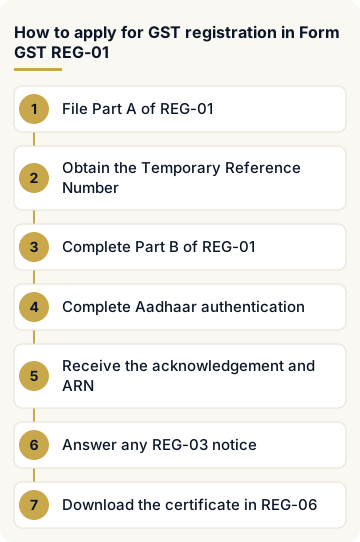
| Stage | Form | What happens |
|---|---|---|
| Declaration | REG-01 Part A | PAN, mobile, email and State. PAN is validated online against the CBDT database; mobile and email are OTP-verified |
| Reference number | TRN | Temporary Reference Number issued; used to log back in and complete Part B. It expires — do not generate it before your premises and constitution documents are in hand |
| Full application | REG-01 Part B | Business details, promoters, authorised signatory, principal and additional places of business, HSN/SAC, bank details. Signed by DSC or EVC; DSC is mandatory for companies and LLPs |
| Acknowledgement | REG-02 | ARN generated |
| Query | REG-03 | Notice seeking clarification, information or documents |
| Reply | REG-04 | Seven working days from receipt of the notice |
| Rejection | REG-05 | Reasons must be recorded in writing |
| Certificate | REG-06 | Downloaded from the portal. No physical certificate is issued or posted. |
| Physical verification report | REG-30 | Uploaded by the officer with GPS-tagged site photographs |
| Exit from Rule 14A | REG-32 / REG-33 | Application to withdraw from the simplified scheme, and the officer's order |
Aadhaar authentication is the single biggest lever on your timeline
Completing Aadhaar authentication for the promoter and authorised signatory moves the application from a thirty-day track to a seven-working-day track. Declining or failing it brings in the proviso to Rule 9(1): thirty days, following physical verification of the place of business. That verification needs the approval of an officer not below the rank of Assistant Commissioner, and the REG-30 report with photographs must be uploaded at least five days before the thirty-day period expires.
Even with Aadhaar done, the portal may send you down a third path. Under Rule 8(4A), applicants identified on the common portal by data analysis and risk parameters must complete biometric Aadhaar authentication, a live photograph, and verification of the original uploaded documents at a designated GST Suvidha Kendra. The facility went live in Maharashtra and Lakshadweep on 8 February 2025 and now operates in every State and Union Territory. It is risk-triggered, not universal — most Nagpur applicants clear on OTP-based Aadhaar authentication and never see a Kendra. When it is triggered, though, the consequence is badly understood: the ARN is generated only after the biometric visit and document verification are complete. A late slot does not delay the clock, it delays the start of the application altogether, and a slot taken too late can let the application lapse.
| Path | Statutory period | Basis | What we see in practice |
|---|---|---|---|
| Rule 14A simplified scheme, opted in, Aadhaar authenticated | 3 working days | Rule 14A | Broadly holds. Genuinely fast for clean small B2B files |
| Rule 9A auto-grant — portal identifies the applicant as low risk | 3 working days from submission | Rule 9A | Automatic and electronic; you cannot apply for it, the portal decides |
| Aadhaar authenticated, not flagged, complete application | 7 working days | Rule 9(1) | Commonly 5 to 10 working days |
| Biometric verification triggered | 7 working days, but the clock effectively starts at biometric completion | Rule 8(4A) | GSK slot availability is the real bottleneck. Add whatever the appointment queue is running at |
| Aadhaar not done, or file flagged as risky | 30 days, after physical verification | Proviso to Rule 9(1); Instruction 03/2025 para 8(iii) | Usually runs close to the full 30 days |
| A REG-03 notice is raised | +7 working days to reply, +7 working days for the officer to decide | Rule 9(3) | Adds two to three weeks in practice |
Rule 14A: three working days, with conditions worth reading twice
The simplified scheme inserted with effect from 1 November 2025 is optional, and it is aimed at small B2B suppliers. It is available where the applicant self-assesses that output tax on supplies made to registered persons will not exceed ₹2,50,000 per month, counting CGST, SGST/UTGST, IGST and compensation cess together. Aadhaar authentication is mandatory to use it, the election is made in Part B of REG-01, and only one Rule 14A registration is permitted per PAN per State or Union Territory — which blocks a second simplified registration for a separate vertical in Maharashtra.
Getting out again takes time. Withdrawal is applied for in Form GST REG-32, with the officer's order in Form GST REG-33. All returns to date must be filed, and an applicant withdrawing before 1 April 2026 needed a minimum of three months' returns; one tax period suffices thereafter. No section 29 cancellation proceedings and no amendment application may be pending. A client who underestimates B2B liability cannot simply switch the option off next month. The figure is ₹2.5 lakh per month, not ₹5 lakh — at least one widely read article carries the higher number and it is wrong.
Do not plan on deemed approval. Rule 9(5) does provide that registration is deemed granted if the officer takes no action within the applicable period. But paragraph 8(vi) of Instruction 03/2025 directs that no application should be approved on a deemed basis for want of timely action, and Chief Commissioners are told to monitor deemed registrations. A registration obtained by the officer's silence invites post-registration scrutiny. Advising a client to sit and wait is not a strategy.
Why applications come back queried, and how to answer a REG-03
Instruction 03/2025 does something unusual: it lists the grounds on which a query is legitimate, exhaustively. Anything outside that list is improper, and knowing the list changes how you reply.
Under paragraph 8(v), a REG-03 notice is properly issued only where: (1) a document is incomplete or illegible; (2) the address of the place of business does not match the uploaded document, or the document does not appear to be valid address proof; (3) the address is incomplete or vague; or (4) any GSTIN linked to the applicant's PAN is cancelled or suspended. Officers are further directed that any document sought beyond the REG-01 list requires the prior approval of the Deputy or Assistant Commissioner.
Three presumptive queries that used to be routine are now formally improper: that the applicant's, director's or authorised signatory's residential address is not in this city or State; that the HSN code declared is for goods banned or prohibited in this State; and that the declared activity cannot be conducted from these premises. If you receive one of these, the correct reply cites paragraph 8 of the instruction rather than supplying a document the officer is not entitled to ask for.
What actually goes wrong, in order of frequency
- Name mismatch across address proofs. Officers are directed to cross-verify address proof against public sources — the land registry, the electricity distribution company's portal, municipal records. A municipal property record in a deceased father's name and an electricity bill in a son's name is a genuine, legitimate trigger. Fix it before filing, not after; correcting a khata takes longer than the entire registration.
- The typed address does not match the document character for character. Plot number, flat number, floor, wing, landmark and PIN must correspond to the uploaded proof. "Near Parivartan Square" on the form and a bill showing a survey number with no landmark reads as ground (2) or (3) to an officer who has never been to Manewada.
- Unclear premises photographs. Where physical verification or biometric document verification happens, the officer's REG-30 carries GPS-tagged photographs. Applicants who supply their own images typically submit an exterior shot at a distance with no signage and no interior. A legible board and a clear interior frame remove an entire round of correspondence.
- HSN or SAC that does not match the stated activity. An officer cannot query your HSN on the ground that the goods are banned. He can, and should, treat a declaration as incomplete when the HSN and SAC codes bear no relation to the described business. A "trading in electrical goods" narrative filed with a services SAC, or a single generic HSN covering a diversified activity, is a self-inflicted query. Map the codes to what you actually supply before Part B is submitted.
- A cancelled or suspended GSTIN on the same PAN. This is ground (4), and it catches promoters more than anyone. A dormant firm, an abandoned proprietorship, or a struck-off company with a cancelled GSTIN sharing the applicant's PAN will surface on the officer's screen. Explain it proactively in the application narrative rather than waiting to be asked, and if the old entity needs to be dealt with properly, do that in parallel — see revival of a struck-off company where the entity is worth recovering.
- DSC and emSigner failures for companies and LLPs, and TRN lapse where Part B is not completed within the validity shown on the portal. Both restart work rather than causing rejection, but both cost days.
Answering the notice
The reply goes in Form GST REG-04 within seven working days of receipt of the REG-03. The officer then has seven working days from receipt of the reply under Rule 9(3) to grant or reject; a rejection comes in Form GST REG-05 with reasons recorded in writing. Two habits make replies work. Answer each numbered query separately and attach the specific document against it rather than re-uploading the original bundle. And where a query is outside the paragraph 8(v) grounds, say so in one sentence, cite the instruction, and still supply anything you legitimately can — an officer who is wrong on the law is still the officer deciding your application. If the seven working days will not be enough because a third party controls the document, file a partial reply within time rather than nothing at all; missing the window converts a query into a rejection, and a rejection means starting again with a fresh Part A.
Regular or composition, decided before you file Part B
A new applicant elects the composition scheme inside REG-01 Part B. An existing registrant can only switch in by filing CMP-02 on or before 31 March of the preceding financial year. Getting this wrong costs a full year.
| Dimension | Regular scheme | Composition scheme |
|---|---|---|
| Turnover ceiling in Maharashtra | None | ₹1.5 crore for goods — traders, manufacturers and restaurants. ₹50 lakh for service providers and mixed suppliers under section 10(2A) |
| Input tax credit | Available, subject to the usual conditions | None — section 10(4). The electronic credit ledger is unavailable and all liability is discharged in cash |
| Charging tax to customers | Tax invoice; GST collected and passed on | Cannot collect GST. Must issue a bill of supply bearing "composition taxable person, not eligible to collect tax on supplies" |
| Inter-State outward supply of goods | Permitted | Barred. One dispatch to Chhattisgarh ends eligibility |
| Supply through an e-commerce operator | Permitted | Goods only, intra-State only, since 1 October 2023. Services through an ECO liable to collect TCS remain barred |
| Signboard | — | Must display "composition taxable person" at every place of business |
| Reverse charge liability | At the applicable rate, with credit where eligible | Payable at normal rates, not composition rates, with no credit |
| Returns | GSTR-1 and GSTR-3B, monthly or under QRMP | CMP-08 quarterly by the 18th, GSTR-4 annually by 30 June |
| Who cannot use it | — | Casual and non-resident taxable persons; suppliers of non-GST goods such as alcoholic liquor for human consumption; manufacturers of notified goods — ice cream and other edible ice, pan masala, tobacco and manufactured tobacco substitutes, aerated water, and specified brick products |
The composition rates, and what the rate rationalisation did not change
| Category | CGST | SGST | Total | Applied to |
|---|---|---|---|---|
| Manufacturers, other than of notified goods | 0.5% | 0.5% | 1% | Turnover in the State — including exempt supplies |
| Traders and other suppliers | 0.5% | 0.5% | 1% | Turnover of taxable supplies only |
| Restaurant service (Schedule II para 6(b)), no alcohol | 2.5% | 2.5% | 5% | Turnover in the State |
| Service providers under section 10(2A) | 3% | 3% | 6% | Turnover in the State |
The turnover base differs between the first two rows and it is not a drafting accident. A manufacturer pays 1% on turnover in the State including exempt supplies; a trader pays 1% on taxable supplies only. A Vidarbha trader with a substantial exempt agricultural line therefore pays materially less than a naive reading of "1% of turnover" suggests.
The rate rationalisation of 22 September 2025 — the 56th GST Council's decision of 3 September 2025, given effect by Notifications 9/2025 to 17/2025-Central Tax (Rate) dated 17 September 2025 — collapsed the old four-slab structure into 5% and 18% as the two principal rates, plus a 40% rate for demerit and luxury goods, alongside 0.25%, 1.5% and 3% for precious stones and bullion. The 12% slab no longer exists. What that changed is the rate a regular registrant charges on its outward supplies. It did not change the composition rates in Rule 7: they remain 1%, 1%, 5% and 6%. Any composition page still quoting 2% for manufacturers is repeating a figure that has been stale since January 2018.
Opting in, staying in, and getting out
Eligibility is judged on aggregate turnover computed PAN-India, and every registration under one PAN must opt in together — you cannot run one State on composition and another on the regular scheme. A goods dealer may also supply services up to 10% of State turnover or ₹5 lakh, whichever is higher, without losing eligibility. On opting in, input tax credit on stock held must be reversed in ITC-03 within 60 days of the commencement of the financial year.
Exit is automatic and unforgiving. The option lapses the moment aggregate turnover crosses the limit, with no grace period. CMP-04 must be filed within 7 days of the triggering event, and ITC-01 within 30 days of withdrawal to claim credit on stock held; credit on capital goods is pro-rated over five years. Composition late fees run at ₹50 per day capped at ₹2,000, or ₹20 per day capped at ₹500 for a nil return. And to close one persistent error: composition taxpayers do not file GSTR-9A, which has been waived since FY 2019-20, and GSTR-4 is due on 30 June, not 30 April — the date moved by Notification No. 12/2024-Central Tax dated 10 July 2024 with effect from FY 2024-25.
The obligations that start the day the certificate is issued
Registration is the cheap part. The recurring calendar is what people underestimate, and Maharashtra sits in the earlier of the two QRMP due-date categories.
| Return | Who files it | Due date |
|---|---|---|
| GSTR-1 | Outward supplies — AATO above ₹5 crore, or anyone not in QRMP | 11th of the following month |
| GSTR-1A | Optional amendment to GSTR-1 | After GSTR-1, before GSTR-3B for the same period |
| GSTR-3B | Summary return and payment, monthly filers | 20th of the following month |
| IFF | QRMP — optional B2B invoices for months 1 and 2 of the quarter | 13th of the following month |
| GSTR-1 quarterly | QRMP — AATO up to ₹5 crore | 13th of the month following the quarter |
| PMT-06 | QRMP — tax payment for months 1 and 2 | 25th of the following month |
| GSTR-3B quarterly | QRMP filers in Maharashtra (Category X) | 22nd of the month following the quarter |
| CMP-08 | Composition taxpayers — statement cum challan | 18th of the month following the quarter |
| GSTR-4 | Composition taxpayers — annual | 30 June following the financial year |
| GSTR-9 | Annual return — mandatory above ₹2 crore AATO, exempt at or below | 31 December following the FY — for FY 2025-26, 31 December 2026 |
| GSTR-9C | Self-certified reconciliation — AATO above ₹5 crore, Rule 80(3) | 31 December following the FY |
QRMP cuts filings from 24 a year to 8, but tax is still paid monthly through PMT-06. The ₹2 crore exemption from GSTR-9 used to be re-notified every year; it was made permanent by Notification No. 15/2025-Central Tax dated 17 September 2025, so there is no longer an annual notification to wait for. A due-date view across GST, ROC and income tax obligations sits on our compliance calendar.
E-invoicing: the test is not last year's turnover
E-invoicing applies where aggregate turnover exceeded ₹5 crore in any financial year from 2017-18 onwards — not merely in the immediately preceding year. Once you cross, you stay in, even if the business has since shrunk. The ₹5 crore threshold took effect on 1 August 2023 under Notification No. 10/2023-Central Tax dated 10 May 2023, and no further reduction has been notified. Separately, businesses with AATO of ₹10 crore or more must report invoices, credit notes and debit notes to the Invoice Registration Portal within 30 days of the document date, effective 1 April 2025; older documents are rejected and no IRN is generated. Businesses between ₹5 crore and ₹10 crore are not currently subject to that 30-day limit. SEZ units (though not SEZ developers), insurers, banking companies and financial institutions including NBFCs, goods transport agencies, passenger transport, cinema admission, and government departments and local authorities are exempt from e-invoicing.
| Default | Per day | Cap |
|---|---|---|
| GSTR-1 or GSTR-3B — nil return | ₹20 (₹10 CGST + ₹10 SGST) | ₹500 |
| GSTR-1 or GSTR-3B — AATO up to ₹1.5 crore | ₹50 (₹25 + ₹25) | ₹2,000 |
| GSTR-1 or GSTR-3B — AATO ₹1.5 crore to ₹5 crore | ₹50 | ₹5,000 |
| GSTR-1 or GSTR-3B — AATO above ₹5 crore | ₹50 | ₹10,000 |
| GSTR-4 — composition annual return | ₹50 (₹20 for nil) | ₹2,000 (₹500 for nil) |
| GSTR-9 / 9C — AATO up to ₹5 crore | ₹50 (₹25 + ₹25) | 0.25% of turnover in the State/UT under each Act |
| GSTR-9 / 9C — AATO ₹5 crore to ₹20 crore | ₹100 (₹50 + ₹50) | 0.25% of turnover in the State/UT under each Act |
| GSTR-9 / 9C — AATO above ₹20 crore | ₹200 (₹100 + ₹100) | 0.25% of turnover in the State/UT under each Act |
| Interest on delayed payment of tax | 18% per annum, section 50(1) — daily, from the due date to the date of payment, no cap | |
| Interest on ITC wrongly availed and utilised | 18% per annum, section 50(3) as substituted by the Finance Act, 2022 with retrospective effect from 01.07.2017. The 24% figure still published by major portals is wrong | |
Four post-registration traps worth writing on the wall
- The 30-day bank account rule — furnish valid bank details within 30 days of registration or before the first GSTR-1 or IFF, whichever is earlier, or face suspension.
- GSTR-3B Table 3 is hard-locked from the July 2025 tax period. Outward liability auto-flows from GSTR-1, GSTR-1A and IFF and cannot be edited in 3B. Corrections must go through GSTR-1A before 3B is filed; after 3B, the error is locked into that period and can only be amended in a later one.
- Invoice Management System deemed acceptance. Invoices left unactioned in IMS are deemed accepted and flow into GSTR-2B. Ignoring IMS lets ineligible or disputed credit auto-populate into your return.
- The three-year bar is absolute. Since 1 August 2025, a return not filed within three years of its due date is barred on the portal. No appeal, no condonation, no workaround. Legacy non-filer clean-ups must be triaged against due dates, immediately.
One more, for anyone moving goods: an e-way bill is required where consignment value exceeds ₹50,000 for inter-State movement, with validity of one day per 200 km for regular cargo, and Part B is what starts the validity clock. Intra-State thresholds are set by each State and several States sit above ₹50,000, so check the Maharashtra notification in force rather than assuming the inter-State figure applies to a delivery within Vidarbha.
Getting the GSTIN inside SPICe+, and what that does not buy you
A company being incorporated can apply for GST registration in the same filing, through Form AGILE-PRO-S (INC-35). It saves a separate application. It does not save any time on the GST side.
AGILE-PRO-S is a mandatory linked web form in every SPICe+ Part B filing, but the GSTIN application inside it is optional — a company may decline it and apply separately in REG-01 later. What is compulsorily bundled is EPFO and ESIC registration and the bank account opening request. For a company whose registered office is in Maharashtra, profession tax registration (PTEC and PTRC) is also compulsorily bundled, which is a genuine Maharashtra-specific convenience most national incorporation pages omit. No fee is charged for the GSTIN, EPFO, ESIC or bank account services in the form.
Three conditions matter. The GSTIN can be applied for only if the address for correspondence is the same as the registered office in SPICe+, because the registered office is treated as the principal place of business for GST. The same director who signs SPICe+ Part B must sign AGILE-PRO-S, and director particulars must match Part B exactly. And a maximum of five directors can be entered.
Now the part that is oversold. Applying through AGILE-PRO-S only transmits the application. MCA passes the data to GSTN, and processing then runs on the ordinary Rule 8 and Rule 9 machinery — same Aadhaar authentication, same risk-based biometric verification, same seven or thirty day periods, same possibility of a REG-03 notice and of outright rejection. Downstream registrations are issued only after the certificate of incorporation and PAN are generated, and GSTN communicates the TRN and ARN first, then the GSTIN or the rejection, by SMS and email. A company can be validly incorporated and still have its GST application refused. Plan the premises documents for the registered office to the same standard as any other application before you file SPICe+ — that work is described on our private limited company incorporation page, and the equivalent questions for an One Person Company and an LLP registration are handled the same way. If the business is outside Vidarbha, the same application is filed identically through our pan-India GST registration route; a comparison of the two vehicles before you commit is on Pvt Ltd versus LLP.
Two related registrations often follow in the same week. DPIIT startup recognition requires the entity to exist but not to be GST-registered, and Udyam registration now draws turnover data from the GST system, so taking Udyam before the GSTIN exists produces a record you will have to update. Once the company is running, the recurring MCA side is set out under private limited annual compliance and annual ROC filings. Businesses in the surrounding districts are served on the same footing — see Wardha and Amravati. Unfamiliar terms on this page are defined in the MCA and GST glossary.
GST registration in Nagpur — common questions
Is the ₹40 lakh GST threshold available to a business in Nagpur?
Yes, but only to a person engaged in the exclusive supply of goods. Maharashtra is a normal-category State and adopted the additional exemption granted by Notification No. 10/2019-Central Tax dated 7 March 2019, so the limit is ₹40 lakh of aggregate turnover for exclusive suppliers of goods and ₹20 lakh for anyone who supplies services or a mix of goods and services. The relief is also withheld from suppliers of ice cream and other edible ice, pan masala, and tobacco and manufactured tobacco substitutes, from anyone covered by section 24, and from anyone who registers voluntarily.
Is biometric Aadhaar verification compulsory for GST registration in Maharashtra?
No. Biometric verification is risk-triggered, not universal. The facility went live in Maharashtra and Lakshadweep on 8 February 2025, and under Rule 8(4A) of the CGST Rules only applicants identified by the common portal on data analysis and risk parameters are called for biometric Aadhaar authentication, a live photograph and verification of the original uploaded documents at a GST Suvidha Kendra. Where it is triggered, the Application Reference Number is generated only after that visit is completed.
How long does GST registration actually take?
It depends on which path the application takes. Rule 9A auto-grant and the Rule 14A simplified scheme, both in force since 1 November 2025, give three working days. Rule 9(1) gives seven working days where Aadhaar authentication is done and the file is not flagged; in practice that runs to five to ten working days. Where Aadhaar is not completed or the portal flags the applicant, the proviso to Rule 9(1) allows thirty days and physical verification of the premises, and it usually runs close to the full period. A notice in REG-03 adds seven working days to reply and a further seven working days for the officer to decide.
Can a composition dealer sell on Amazon or Flipkart?
Only goods, and only within the State. The blanket bar on composition dealers supplying through an e-commerce operator was removed with effect from 1 October 2023 for suppliers of goods, provided the supplies are intra-State. The bar survives for services supplied through an e-commerce operator required to collect tax at source under section 52. A composition dealer also cannot make any inter-State outward supply of goods, so a Nagpur seller shipping to Raipur cannot remain in the scheme.
What should I do if I receive a REG-03 notice?
Reply in Form GST REG-04 within seven working days of receipt. The officer then has seven working days from receipt of the reply to decide under Rule 9(3), and a rejection must be recorded in writing in Form GST REG-05. CBIC Instruction No. 03/2025-GST dated 17 April 2025 limits legitimate queries to four grounds: an incomplete or illegible document, an address that does not match the uploaded document or a document that is not valid address proof, an incomplete or vague address, and a GSTIN linked to the same PAN that is cancelled or suspended. Where a query falls outside those grounds, the reply should say so and cite the instruction rather than supply a document the officer is barred from demanding.
Do I need a separate GST registration for each State?
Yes. Registration is State-wise. A business with a place of business in Nagpur and another in Mumbai holds two GSTINs on the same PAN, and each files its own returns. Aggregate turnover, by contrast, is computed PAN-India across all registrations and includes exempt supplies, exports and inter-State supplies, which is why businesses that compute turnover State by State routinely understate it and register late.
Sources & further reading
- CBIC Instruction No. 03/2025-GST dated 17 April 2025 — processing of registration applications: the sufficient premises documents, the documents officers may not demand, and the exhaustive grounds for a REG-03 query.
- CBIC Circular No. 246/03/2025-GST dated 30 January 2025 — late fee on the annual return runs as a single continuous computation until both GSTR-9 and GSTR-9C are furnished.
- Goods and Services Tax portal — where REG-01 is filed and REG-06 is downloaded, and where GSTN advisories on biometric authentication and IMS are published.
- CBIC GST portal — the Acts, Rules, notifications, circulars and instructions in their current form.
- PIB — Recommendations of the 56th GST Council, 3 September 2025 — the rate rationalisation given effect from 22 September 2025.
- CGST & Central Excise, Nagpur Zone — the Central jurisdiction for a Nagpur registrant, with the commissionerate and division map.
Statutory positions stated on this page are current as at 25 October 2026. Rates, thresholds, forms and due dates change, and several of the reliefs described here rest on notifications that are amended from time to time. Confirm the position in force before acting on it. Nothing here is a substitute for advice on your own facts.
GST registration and scheme advice
The two decisions worth taking before Part B is submitted are the scheme election and the premises document set. Both are difficult to unwind afterwards. Which path the application takes turns on the constitution of the applicant and the premises position.
Manewada, Nagpur – 440027
Mon–Sat 11:00–19:30 · Sunday closed · English, Hindi, Marathi
What the engagement covers
- Threshold and section 24 analysis before you file
- Premises document set tested against Instruction 03/2025
- REG-01 Parts A and B, HSN and SAC mapping
- Aadhaar authentication and GSK coordination where triggered
- Replies to REG-03 notices in REG-04
- Regular versus composition election, and the post-GSTIN calendar