LLP Registration in Nagpur
Incorporation under the LLP Act, 2008 — name reservation, FiLLiP, the LLP Agreement and Form 3 — with the real fee schedule, the real deadlines, and the one default that surfaces years later.
Contact the officeHow is an LLP registered, and what makes it different?
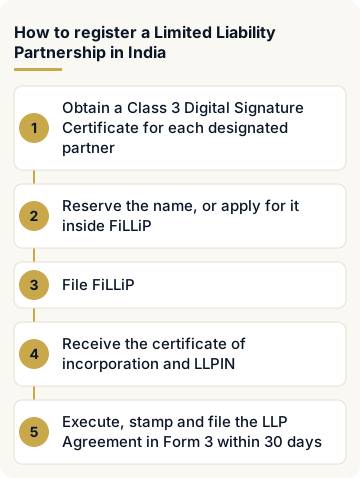
An LLP is incorporated by filing FiLLiP with the Registrar under Rule 11 of the LLP Rules, 2009. The name is either reserved first through the RUN-LLP web service — valid for three months under Rule 18(6) — or applied for inside FiLLiP itself. It needs two partners (s.6(1)) and two designated partners, at least one of them resident in India, meaning present in India for not less than 120 days in the financial year (s.7(1)). There is no minimum contribution. The government registration fee is driven entirely by contribution and runs from ₹500 to ₹25,000. What separates an LLP from a private limited company is running cost: no statutory audit until turnover exceeds ₹40,00,000 or contribution exceeds ₹25,00,000 (Rule 24(8)), only two annual ROC forms — Form 11 by 30 May and Form 8 by 30 October — and no board-meeting or AGM machinery. The LLP Agreement must then be filed in Form 3 within 30 days of incorporation (s.23(2)–(3) read with Rule 21(1)). That last deadline is the one most LLPs miss.
- ✓ Law: LLP Act, 2008 · LLP Rules, 2009
- ✓ Incorporation form: FiLLiP (Rule 11)
- ✓ Partners: minimum 2; one designated partner Indian-resident
- ✓ Registration fee: ₹500–₹25,000, set by contribution
- ✓ Annual forms: Form 11 (30 May) · Form 8 (30 October)
- ✓ Audit: only above ₹40 lakh turnover or ₹25 lakh contribution

An LLP is cheaper to run than a private limited company — here is exactly where the money goes
Founders usually pick between the two structures on incorporation cost. That is the smaller number. The difference that compounds is the annual burden, and almost all of it comes from three places: the statutory audit, the number of ROC forms, and the meeting machinery.
| Dimension | Private limited company | LLP |
|---|---|---|
| Statutory audit | Mandatory from day one, at any turnover — s.139 | Only where turnover exceeds ₹40,00,000 or contribution exceeds ₹25,00,000 — Rule 24(8) |
| Annual ROC forms | AOC-4 and its variants, MGT-7 or MGT-7A, ADT-1 on auditor appointment, DPT-3 annually, MSME-1 half-yearly where applicable, PAS-6 half-yearly for non-small private companies | Form 11 and Form 8. That is the whole annual ROC list |
| Board meetings | Minimum four a year; two for a small company or OPC | None unless the LLP Agreement itself requires them |
| Annual general meeting | Mandatory — s.96 | Not required |
| Statutory registers | Members, directors and KMP, charges, significant beneficial owners, loans and investments, related-party contracts | Register of partners in Form 4A (G.S.R. 803(E) dated 27 October 2023) and SBO compliance under the LLP (Significant Beneficial Owners) Rules, 2023 (G.S.R. 832(E) dated 9 November 2023) |
| KYC of DIN / DPIN holders | DIR-3 KYC Web — triennial, due 30 June, from 31 March 2026 (G.S.R. 943(E) dated 31 December 2025) | Identical. A DPIN is a DIN, so designated partners file DIR-3 KYC Web on the same cycle |
| Late annual filing | Additional fee of ₹100 per day per form, uncapped — first proviso to s.403 | Slab multiplier of the contribution-linked normal fee, roughly halved for a small LLP — s.69 and Annexure A |
| Amnesty in 2026 | Yes, now closed — CCFS-2026 waived 90% of the additional fee until 15 September 2026 | No. LLP forms were outside CCFS-2026 |
The audit line is the one with real money behind it. A private limited company appoints a statutory auditor in its first month and pays for an audit every year whether it trades or not. An LLP below both Rule 24(8) limits does not, and for a consultancy, a professional practice or a family trading business that is usually the largest single line in the annual compliance bill. Most of the rest of that table is measured in professional time rather than fees.
One qualification: the gap narrowed on 1 December 2025, when G.S.R. 880(E) raised the "small company" limits to ₹10 crore paid-up capital and ₹100 crore turnover. Almost every owner-managed private company now sits inside that definition, which means MGT-7A instead of MGT-7, two board meetings instead of four, and no PAS-6. Any page still quoting ₹4 crore and ₹40 crore as the small-company limits has been out of date since 1 December 2025. The structural comparison, including the tax treatment of partner remuneration, sits on the dedicated Pvt Ltd versus LLP comparison; if the company route is the right one, the procedure is on private limited company incorporation in Nagpur and the recurring cycle on private limited annual compliance. Either way the first purchase is the same — a Class 3 Digital Signature Certificate for every person who will sign.
Name, FiLLiP, DPIN and what each partner has to produce
Incorporation is four filings deep, and the differences from a company incorporation are procedural rather than cosmetic. Each one you get wrong costs a resubmission cycle.
The name, and the rule that does not transfer from companies
An LLP name can be reserved on its own through the RUN-LLP web service, or applied for inside FiLLiP. Rule 18(6) fixes the validity of a reserved name at three months from the date of intimation by the Registrar. That is a materially different regime from companies, where a name approved through SPICe+ Part A for a new company lasts 20 days and can be extended to 40 or 60 days on payment under Rule 9A of the Companies (Incorporation) Rules, 2014. There is no Rule 9A-style paid extension for an LLP name. Content describing an LLP name as valid for 20 days, or extendable for ₹1,000, has transplanted the company rule.
Reserving first costs an extra ₹200 and an extra processing cycle, but it isolates the risk: a rejection kills the name application, not the incorporation. Applying for the name inside FiLLiP is faster, and a name objection then bounces the entire filing. RUN-LLP allows one resubmission with a 15-day window; FiLLiP allows two. Run the trade mark search before either step, because a conflict with a registered mark is the commonest reason a name is refused — see trade mark registration if the name is one you intend to protect.
FiLLiP, and the DPIN misconception
FiLLiP is filed under Rule 11, signed by a designated partner and certified by a practising Chartered Accountant, Company Secretary or Cost Accountant. Up to five designated partners may apply for a DPIN inside the form — a limit raised from two by the LLP (Amendment) Rules, 2022. There is no separate DPIN application for an incorporation, and any step-by-step process listing "apply for DPIN" as a stage before FiLLiP is describing a procedure that no longer exists. A partner who already holds a DIN from a company directorship uses that DIN; a DPIN and a DIN are the same identifier, which is why designated partners are caught by the same KYC cycle as directors.
Note where the file is actually processed. Incorporation applications go to the Central Registration Centre at Manesar, not to the jurisdictional Registrar. The Registrar of Companies at Nagpur was established by MCA notification S.O. 4850(E) dated 23 October 2025 and took jurisdiction on 16 February 2026 over 18 districts — the 11 Vidarbha districts plus seven of Marathwada. That office matters for adjudication, inspection, inquiry and physical records; it does not process your FiLLiP. The full map is on ROC offices and jurisdiction in India.
| From | What is needed | The point that causes rework |
|---|---|---|
| Every Indian partner | PAN, Aadhaar, passport-size photograph, mobile number and email | The name on the DSC must match the PAN exactly — an expanded middle name or a dropped initial is enough to fail the signature check |
| Every Indian partner | Address proof — recent bank statement or utility bill | Two months is the working currency limit; a bill in a vernacular script needs an English translation |
| Every designated partner | Class 3 Digital Signature Certificate, plus written consent to act | The consent and the subscriber sheet must be signed by the same person whose DSC is affixed to the form |
| At least one designated partner | Residence in India — not less than 120 days in the financial year, s.7(1) Explanation | The threshold was cut from 182 days with effect from 1 April 2022. NRI-partner structures planned on the old number fail |
| Foreign partner | Passport and address proof, notarised and apostilled or consularised | The sequence — notarisation first, then apostille — is regularly done the wrong way round and has to be repeated abroad |
| Registered office | Latest utility bill, NOC from the owner, rent or lease agreement; or the sale deed and property tax receipt if owned | The name on the utility bill must reconcile to the NOC and the rent agreement. A bill still in a deceased parent's name is the classic Nagpur example |
| The business itself | Proposed objects and the matching NIC code | An object clause that does not correspond to the declared NIC code draws a resubmission |
What it costs the government
Everything on the LLP fee schedule is driven by the total contribution of the partners — not by turnover, and not by share capital, because an LLP has none. Annexure A to the LLP Rules, 2009 was substituted by the LLP (Amendment) Rules, 2022, G.S.R. 109(E) dated 11 February 2022, effective 1 April 2022, which is when the upper slabs were added. Tables showing registration capped at ₹5,000 and filing fee capped at ₹200 are pre-April-2022 text.
| Total contribution of the partners | Registration fee (FiLLiP) | Normal filing fee per document — Forms 3, 4, 8, 11 |
|---|---|---|
| Up to ₹1,00,000 | ₹500 | ₹50 |
| Above ₹1,00,000 up to ₹5,00,000 | ₹2,000 | ₹100 |
| Above ₹5,00,000 up to ₹10,00,000 | ₹4,000 | ₹150 |
| Above ₹10,00,000 up to ₹25,00,000 | ₹5,000 | ₹200 |
| Above ₹25,00,000 up to ₹1,00,00,000 | ₹10,000 | ₹400 |
| Above ₹1,00,00,000 | ₹25,000 | ₹600 |
Add ₹200 if the name is reserved separately through RUN-LLP, the cost of a Class 3 DSC for each designated partner, and State stamp duty on the LLP Agreement. The stamp duty is the item that catches people out, and it is dealt with in the next section. Comparable statutory fees for other registrations are collected on government fees in India, and the company-side additional-fee arithmetic on the MCA and ROC fee calculator.
Set the contribution deliberately, and set it low. Unlike a company's authorised capital, LLP contribution is not a paper number — it is what the partners have actually agreed to bring in, and it is stated in Form 3. Crossing ₹25,00,000 does three things at once: it triggers compulsory audit under Rule 24(8), it loses small-LLP status and doubles every future additional fee, and it moves the LLP two fee slabs up. Contribution can be increased later, and Form 3 on an increase charges only the difference between the new slab's fee and the fee already paid, so starting low costs nothing later. Further funding is usually better introduced as partner loans than as contribution.
The timeline, and what goes wrong
A Class 3 DSC is normally issued within one to two working days; a clean RUN-LLP name approval takes one to three working days; FiLLiP processing at the Central Registration Centre typically runs three to seven working days. What actually stretches the job is the last stage — agreeing commercial terms, drafting the LLP Agreement, buying State stamp paper and filing Form 3. A typical range is 12 to 20 working days to the LLPIN, allowing for document collection and one resubmission; this is a processing estimate, not a statutory period or a commitment. The LLP Agreement must then be filed in Form 3 within 30 days of incorporation, the statutory limit under section 23(2) of the LLP Act, 2008 read with Rule 21(1). One resubmission adds a week or more.
The recurring causes of a FiLLiP resubmission, in rough order of frequency: a name conflicting with a registered trade mark or an existing company or LLP; registered-office proof that does not reconcile, most often a utility bill older than two months or in a name that does not match the NOC and the rent agreement; a DSC whose holder name does not match the PAN exactly; a consent or subscriber sheet signed by someone other than the DSC holder; an object clause inconsistent with the declared NIC code; and, for foreign partners, apostille or notarisation done out of sequence. None of these are exotic. They are document-control failures, and they are cheaper to fix before filing than after.
If the partners sit outside Vidarbha, none of this needs a visit — the process runs on Aadhaar e-KYC and digital signatures throughout. That route is described on pan-India online LLP registration.
The Form 3 trap: 30 days, no headline penalty, and years of consequences
Section 23(2) and (3) of the LLP Act, read with Rule 21(1), requires the LLP Agreement to be filed in Form 3 within thirty days of the date of incorporation. Rule 21(2) applies the same 30 days to every later change in the agreement. This is the most commonly ignored LLP obligation in the country, and the reason is precise: no fixed rupee penalty is attached to it.
First, correct the additional fee — it is not ₹100 a day
The flat additional fee of ₹100 per day for LLP forms was abolished on 1 April 2022. Section 69 of the LLP Act was substituted by the LLP (Amendment) Act, 2021 to permit different fees for different classes of LLP, and Annexure A was replaced by G.S.R. 109(E) with a slab-multiplier structure that is roughly half as steep for a small LLP. Sites still publishing "₹100 per day, no cap" for LLP forms — including pages dated 2026, and several late-fee calculators built around that phrase — are describing a regime that ended more than four years ago.
| Period of delay | Small LLP | Any other LLP |
|---|---|---|
| Up to 15 days | 1× normal fee | 1× normal fee |
| More than 15 and up to 30 days | 2× | 4× |
| More than 30 and up to 60 days | 4× | 8× |
| More than 60 and up to 90 days | 6× | 12× |
| More than 90 and up to 180 days | 10× | 20× |
| More than 180 and up to 360 days | 15× | 30× |
| Beyond 360 days | 25× — flat, no per-day component | 50× — flat, no per-day component |
Worked: a small LLP that files Form 3 seventy days late
Take an LLP with total contribution of ₹4,00,000, which puts its normal filing fee at ₹100 and, with turnover under ₹40,00,000, keeps it inside the small-LLP definition. Form 3 was due 30 days after incorporation and is filed on day 100 — a delay of 70 days, which falls in the "more than 60 and up to 90 days" band.
| Basis | Additional fee | Total with the ₹100 normal fee |
|---|---|---|
| Current law — 6× the normal filing fee for a small LLP | 6 × ₹100 = ₹600 | ₹700 |
| The same LLP if it were not a small LLP — 12× | 12 × ₹100 = ₹1,200 | ₹1,300 |
| What is still widely published — "₹100 per day" | ₹100 × 70 = ₹7,000 | ₹7,100 |
Even two years late, the additional fee on Form 3 for that LLP is 25 × ₹100 = ₹2,500, flat, because the beyond-360-day multiplier for forms other than Form 8 and Form 11 carries no per-day rider. That is the whole problem. The fee is never frightening enough to force the filing, so the filing does not happen — and the real consequences are not monetary at all.
What an unfiled Form 3 actually costs
The agreement the partners negotiated is not on record. Until Form 3 is filed and approved, the mutual rights and duties of the partners are governed by the default provisions in the First Schedule to the LLP Act: equal profit shares regardless of contribution, equal management rights, no partner entitled to remuneration, and unanimous consent to admit a new partner. A 70:30 split that everyone signed and nobody filed is, on the record, 50:50.
It creates a live tax exposure. Partner remuneration is deductible under section 35(e) of the Income-tax Act, 2025 (formerly section 40(b) of the 1961 Act) only if it is authorised by, and paid in accordance with, the LLP agreement. An LLP paying remuneration on an agreement that was never registered has a disallowance argument standing against it. Separately, and unconnected to Form 3, section 393(3) of the Income-tax Act, 2025 (formerly section 194T, in force from 1 April 2025) requires 10% TDS on salary, remuneration, commission, bonus and interest paid or credited by a firm or LLP to a partner once the aggregate crosses ₹20,000 in the financial year — and TDS then applies to the whole amount, not merely the excess. Share of profit is outside it. A very large number of LLPs missed this in their first year of operation.
Downstream filings jam. Form 4 for a change of partners, and every later Form 3, cannot be processed on MCA V3 until the base Form 3 is approved. That is when it surfaces — the LLP tries to admit a partner, change the profit-sharing ratio, convert into a company, take a bank facility or strike itself off, and discovers a four-year-old omission standing in the way. It is a sleeping liability, and not a small one.
Stamp duty is not collected through FiLLiP. Unlike SPICe+, where duty on the memorandum and articles is collected on the MCA payment screen, an LLP Agreement must be executed on State stamp paper before Form 3 is filed — and the 30-day clock does not stop while you wait for the paper. This is the single commonest reason the deadline is missed, and it is entirely avoidable by starting the drafting on the day FiLLiP is submitted rather than on the day the certificate arrives. Maharashtra stamp duty on an LLP agreement is a Schedule I question under the Maharashtra Stamp Act, 1958 and should be confirmed for the specific instrument before execution rather than taken from a published table: several widely mirrored tables have not been updated since the Maharashtra Stamp (Amendment) Ordinance of 14 October 2024 revised a long list of duties.
Form 11 by 30 May, Form 8 by 30 October — and who is allowed to certify them
Two forms, two dates, two different certification tests and an unforgiving sequence. Filing is compulsory whether or not the LLP traded, and whether or not it has any income.
| Dimension | Form 11 — Annual Return | Form 8 — Statement of Account and Solvency |
|---|---|---|
| Statutory basis | s.35(1) read with Rule 25(1) | s.34(2)–(3) read with Rule 24(4) |
| Period allowed | Within 60 days of closure of the financial year | Within 30 days from the end of six months of the financial year |
| Due date | 30 May | 30 October |
| FY 2025-26 | 30 May 2026 — passed | 30 October 2026 |
| FY 2026-27 | 30 May 2027 | 30 October 2027 |
| Signed by | Two designated partners, with DSC | Two designated partners, with DSC |
| Professional certification | Where turnover is up to ₹5 crore or contribution up to ₹50 lakh, a certificate from a designated partner other than the signatory; in all other cases, a certificate from a Company Secretary in practice — Rule 25(2). Because of the “or”, guidance differs on how the limits combine; the safe course is the Company Secretary’s certificate once either is exceeded | Certified by a practising Chartered Accountant, Company Secretary or Cost Accountant. Where the LLP is subject to audit, also signed by the auditor — Rule 24(6) |
| Penalty for default | s.35(2) — ₹100 per day, maximum ₹1,00,000 on the LLP and ₹50,000 on the designated partners | s.34(5) — ₹100 per day, maximum ₹1,00,000 on the LLP and ₹50,000 on the designated partners |
Two thresholds that look alike and are not. The audit trigger is ₹40 lakh of turnover or ₹25 lakh of contribution. The PCS-certification of Form 11 trigger is ₹5 crore of turnover or ₹50 lakh of contribution, on the safe reading of Rule 25(2). They are unrelated tests under different rules, and they are conflated constantly. An LLP can be well past the audit line and still have Form 11 certified internally, because the certification test turns on the much higher figures.
Sequence matters. Form 11 must be filed before Form 8 for the same financial year. An LLP that misses 30 May therefore compounds its Form 8 exposure automatically, because it cannot file Form 8 on 30 October until Form 11 is through. Two delayed forms, two separate additional fees.
The audit line itself. Rule 24(8) exempts an LLP whose turnover does not exceed ₹40,00,000 or whose contribution does not exceed ₹25,00,000. As drafted the rule reads disjunctively, which on a literal reading would exempt an LLP with ₹5 crore of turnover but ₹10 lakh of contribution. Universal professional practice, and the way the requirement is applied, is the conjunctive reading: audit becomes compulsory once either limit is crossed. The auditor must be a Chartered Accountant in practice, appointed by the designated partners, and partners may elect a voluntary audit below the limits. This is a different test from income-tax audit under section 63 of the Income-tax Act, 2025 (formerly section 44AB of the 1961 Act), which has its own thresholds — a ₹30 lakh-contribution LLP with zero turnover needs an LLP-Act audit and no tax audit at all.
Additional fee on Form 8 and Form 11 — a different table from Form 3
| Period of delay | Small LLP | Any other LLP |
|---|---|---|
| Up to 15 days | 1× normal fee | 1× normal fee |
| More than 15 and up to 30 days | 2× | 4× |
| More than 30 and up to 60 days | 4× | 8× |
| More than 60 and up to 90 days | 6× | 12× |
| More than 90 and up to 180 days | 10× | 20× |
| More than 180 and up to 360 days | 15× | 30× |
| Beyond 360 days | 15× normal fee, plus ₹10 per day for delay beyond 360 days | 30× normal fee, plus ₹20 per day for delay beyond 360 days |
Beyond 360 days there is no monetary ceiling on Form 8 and Form 11 — the per-day rider runs indefinitely. No worked total is published here for that band, because the exact computation of the rider is stated inconsistently across the reproductions in circulation and the portal's own figure governs. Generate it on the MCA fee enquiry service on the day you file, and note that the fee accrues per form: an LLP that has filed neither Form 8 nor Form 11 for a year is carrying two separate additional fees, not one.
Additional fee is what you pay the Registrar to be allowed to file. The penalty under s.34(5) or s.35(2) is what an adjudicating officer imposes for having defaulted, under s.76A read with Rule 37A. They are cumulative, not alternatives, and both replaced the old fines of ₹25,000 to ₹5,00,000 on 1 April 2022 — figures that are still all over the internet. The reproduced wording does not make clear whether the ₹50,000 designated-partner ceiling is per partner or in aggregate, so no aggregate figure is quoted here. There is a third exposure worth naming: section 164 of the Companies Act was applied to LLPs by G.S.R. 110(E) dated 11 February 2022, along with sections 90, 165, 167, 206(5), 207(3), 252 and 439. How far s.164 disqualification bites on an LLP's Form 8 and Form 11 defaults has not been settled in reported practice, but it puts the designated partners' DINs — and therefore their directorships in other companies — into the conversation. Quoting a client the additional fee alone understates the position considerably.
LLPs get no amnesty, and this is the point almost every competing page gets wrong. The Companies Compliance Facilitation Scheme, 2026 waived 90% of accumulated additional fee on overdue company annual filings until it closed on 15 September 2026 — opened by General Circular No. 01/2026 of 24 February 2026 and extended by No. 03/2026 of 8 July 2026 and No. 04/2026 dated 31 August 2026. It was a Companies Act scheme. LLP forms were outside it. No LLP scheme has been signalled for 2026 — the last one was the LLP Settlement Scheme, 2020 — so an LLP in default pays its full contribution-linked additional fee. Companies have a narrower relief: General Circular No. 05/2026 waives the additional fee on FY 2025-26 AOC-4 filed by 31 December 2026 and MGT-7 or MGT-7A filed by 31 January 2027. The compliance calendar maps both entities by date; annual ROC filings covers the company side.
"Small LLP" — what it is, and what it is worth
Section 2(1)(ta) of the LLP Act, inserted by the LLP (Amendment) Act, 2021 and brought into force on 1 April 2022 by S.O. 621(E) dated 11 February 2022, defines a small LLP as one whose contribution does not exceed ₹25,00,000 and whose turnover, as per the Statement of Account and Solvency for the immediately preceding financial year, does not exceed ₹40,00,000. The section is drafted with "and". Both limbs must be satisfied. An LLP with ₹10 lakh of contribution and ₹60 lakh of turnover is not a small LLP and pays double additional fee on everything it files late.
The Act allows the Central Government to prescribe higher amounts — up to ₹5 crore of contribution and ₹50 crore of turnover — but no higher amount has been prescribed. The limits are still ₹25 lakh and ₹40 lakh. Note the trap: G.S.R. 880(E) of 1 December 2025 raised the Companies Act small-company limits to ₹10 crore and ₹100 crore. That change has nothing to do with LLPs and does not move the small-LLP line.
What the status is worth is narrow and concrete: roughly half the additional fee on every late filing. It is also re-tested every year on the preceding year's turnover, so an LLP that crossed ₹40 lakh of turnover in FY 2025-26 is not a small LLP for its FY 2026-27 filings, and a default that would have cost 15× costs 30×. Clients assume the classification is permanent. It is not.
One more recurring date. Designated partners file DIR-3 KYC Web, because a DPIN is a DIN. That obligation became triennial and due by 30 June from 31 March 2026, under G.S.R. 943(E) dated 31 December 2025 — no longer annual, and no longer 30 September. Late filing or DIN reactivation costs ₹5,000, and a deactivated DIN stops the holder signing any e-form anywhere. Details on DIR-3 KYC filing.
When an LLP is the wrong choice
An LLP has no share capital. That single structural fact rules it out of an entire class of transactions, and no amount of drafting in the LLP Agreement works around it. If any of the following is on the horizon within three years, incorporate a private limited company instead.
| What you want to do | Private limited company | LLP |
|---|---|---|
| Issue equity shares to an investor | Yes | Not possible — there is no share capital to issue |
| Issue preference shares, CCPS, CCDs, convertible notes or a SAFE | Yes | No legal vehicle exists. Liquidation preference, anti-dilution and conversion ratios have nothing to attach to, and there is no cap table |
| Grant ESOPs to employees | Yes — s.62(1)(b) | No. ESOPs run on share capital. A profit-share or "phantom" arrangement in an LLP agreement is contractual, not a security, and is taxed as income |
| Take investment from an FPI or an FVCI | Yes | FPIs and FVCIs are not eligible investors in an LLP |
| Take foreign direct investment | Across the automatic-route sectors, including those carrying FDI-linked performance conditions | Only where the sector permits 100% FDI under the automatic route and carries no FDI-linked performance conditions. Otherwise it is simply unavailable |
| Use presumptive taxation at a deemed percentage of receipts | Not available to companies either | Section 58 of the Income-tax Act, 2025 (formerly sections 44AD and 44ADA) expressly excludes an LLP. An identical proprietorship or traditional partnership firm can use it; a consultancy LLP cannot |
| Obtain DPIIT start-up recognition | Yes | Yes — "eligible start-up" is defined as a company or a limited liability partnership |
The FDI position is worth stating precisely, because it is usually rendered as either "LLPs can take FDI" or "LLPs cannot", and both are wrong. Under the Foreign Exchange Management (Non-Debt Instruments) Rules, 2019, foreign investment into an LLP is permitted only in sectors that are 100% automatic with no performance conditions, and in practice there is no government-approval fallback where the sector fails that test. Where it is permitted, contribution must come in at not less than a fair price computed by an internationally accepted valuation norm and certified by a Chartered Accountant, Cost Accountant or approved valuer, and reporting runs on Form FDI-LLP(I) within 30 days of receipt of the amount, Form FDI-LLP(II) within 60 days for a transfer or disinvestment, and the annual FLA return by 15 July. Downstream investment by an LLP carries the same sector test, with the compliance onus on the recipient LLP.
The practical read: LLPs suit bootstrapped, service-led, professional and family businesses that will fund themselves from cash flow or partner loans. Founders who later raise institutional money convert into a private limited company, which is a normal and well-trodden path — but it is a project, not a form, and it should start well before a term sheet is signed. DPIIT recognition itself does not require a company; see DPIIT Startup India recognition and Startup India registration in Nagpur. An LLP crossing the GST threshold registers exactly as a company does — see GST registration in Nagpur.
Closing an LLP, and converting it into a company
Form 24 — voluntary strike off
Under section 75 read with Rule 37(1)(b), an LLP that has not carried on business or operation for one year or more may apply in Form 24, with the consent of all partners, to have its name struck off. The government fee is ₹500. Since 27 August 2024, under the LLP (Amendment) Rules, 2024 (G.S.R. 475(E) dated 5 August 2024), the application is processed centrally by the Registrar, C-PACE at Manesar — not by the jurisdictional Registrar. Any page telling a Nagpur client to file LLP closure with the State ROC is two years out of date. The application is published on the MCA website for one month before the name is struck off, and the liability of every designated partner continues afterwards as if the LLP had not been dissolved.
Rule 37(1A) sets the pre-conditions. The one that saves real money: overdue Form 8 and Form 11 must be filed up to the end of the financial year in which the LLP ceased to carry on business — not for the dormant years after that. Most sites get this wrong and quote clients for a full catch-up. Form 24 also needs a statement of account showing NIL assets and NIL liabilities, certified by a Chartered Accountant in practice and made up to a date not earlier than 30 days before filing; an affidavit of the designated partners stating the date of cessation, confirming there are no liabilities, indemnifying anything that arises later and confirming the bank accounts are closed; the latest income-tax return acknowledgment; and, where Form 3 was never filed, the initial LLP agreement itself.
What gets Form 24 returned, in rough order of frequency: pending Form 8 and Form 11 up to the cessation year; a bank account left open, including a forgotten zero-balance account, where C-PACE wants a closure certificate rather than a nil statement; an affidavit on plain paper or unnotarised; a NIL-asset statement dated more than 30 days back; a DSC not registered against the LLP on MCA V3, or expired; a live GSTIN, which is hard to reconcile with a claim that business has ceased; and a partner who cannot be traced, since Rule 37(1)(b) requires the consent of all partners with no majority override.
One structural point that changes the arithmetic: there is no LLP equivalent of dormant status. A company can file MSC-1 and go quiet. An LLP that is not trading still owes Form 8 and Form 11 every year, with additional fee accruing on each. For a genuinely dead LLP, Form 24 at ₹500 plus the catch-up filings to the cessation year is almost always cheaper than carrying it. The company-side equivalent, and the Registrar's own strike-off powers, are covered on company strike off in India.
Conversion into a private limited company under section 366
There is no provision in the LLP Act for conversion into a company. It is done entirely under section 366 of the Companies Act, 2013, read with the Companies (Authorised to Register) Rules, 2014 and Form URC-1 filed alongside SPICe+. Section 366(1) expressly includes a limited liability partnership within the word "company" for that Part. The minimum is two or more members — the Companies (Amendment) Act, 2017 cut it from seven with effect from 15 August 2018, so any source still saying "at least seven partners are needed to convert" is quoting repealed law.
The steps that consume the calendar are not the Registrar's. An advertisement in Form URC-2 must run in two newspapers, one English and one in the vernacular, circulating in the district, inviting objections within 21 clear days. A no-objection is needed from the Registrar with whom the LLP is registered, and consents from creditors, particularly secured creditors. A statement of accounts prepared not more than 15 days before the application and certified by an auditor must accompany it (Rule 3, Companies (Authorised to Register) Rules, as amended from 23 January 2023). A typical end-to-end range is 30 to 60 working days, of which Registrar processing is 15 to 30.
What actually blocks a conversion: pending LLP filings, which are checked — an unfiled Form 8, Form 11 or Form 3, or a designated partner whose DIR-3 KYC is not done, gets URC-1 returned, and cleaning that up is usually the longest part of the job; a secured lender that will not give a clean NOC, since banks generally prefer to re-document the facility rather than consent to a change of borrower; and MIDC leasehold land, which adds a lessor consent on top — a live issue at Butibori and Hingna, where a change of constitution needs MIDC's prior written consent under the lease deed and attracts transfer charges. There is also a tax constraint founders walk into regularly: shares in the new company must be allotted to the partners in the same proportion as their capital accounts stood in the LLP. Re-cutting the equity at the conversion to accommodate an incoming investor breaks the tax-neutrality conditions and can turn a paper reorganisation into a taxable event. If a funding round is the reason for converting, start six months out. The subsequent issue of shares to the investor is a separate exercise — see share allotment and transfer.
LLP registration — common questions
How long does LLP registration in Nagpur actually take?
A Class 3 DSC is normally issued within one to two working days. A clean RUN-LLP name approval takes one to three working days. FiLLiP processing at the Central Registration Centre typically runs three to seven working days. A typical range is 12 to 20 working days to the LLPIN, allowing for document collection and one resubmission; this is a processing estimate, not a statutory period or a commitment. The LLP Agreement must then be filed in Form 3 within 30 days of incorporation, the statutory limit under section 23(2) of the LLP Act, 2008 read with Rule 21(1). A single resubmission adds a week or more, and FiLLiP allows two resubmissions with a 15-day window each.
What is the government fee to register an LLP?
The registration fee is set by the total contribution of the partners, not by turnover: ₹500 up to ₹1,00,000; ₹2,000 above ₹1,00,000 up to ₹5,00,000; ₹4,000 above ₹5,00,000 up to ₹10,00,000; ₹5,000 above ₹10,00,000 up to ₹25,00,000; ₹10,000 above ₹25,00,000 up to ₹1,00,00,000; and ₹25,000 above ₹1,00,00,000. Add ₹200 if the name is reserved separately through RUN-LLP, State stamp duty on the LLP Agreement, and the cost of a Digital Signature Certificate for each designated partner. The binding figure is the one the MCA portal computes at the moment of filing.
What happens if the LLP Agreement is not filed in Form 3 within 30 days?
There is no fixed rupee penalty for late Form 3. The additional fee under section 69 is slab-based: for a small LLP it runs at 1, 2, 4, 6, 10 and 15 times the normal filing fee by band of delay, and 25 times flat beyond 360 days. For an LLP that is not a small LLP the multipliers are 1, 4, 8, 12, 20, 30 and 50 times. The larger consequences are not monetary. Until Form 3 is on record the default provisions in the First Schedule to the LLP Act govern the partners' mutual rights — equal profit shares and no partner entitled to remuneration — and Form 4 and subsequent Form 3 filings cannot be processed.
Does an LLP need a statutory audit?
Only above the limits in Rule 24(8) of the LLP Rules, 2009: turnover of ₹40,00,000 or contribution of ₹25,00,000. Audit becomes compulsory once either limit is crossed, and the auditor must be a Chartered Accountant in practice. This is a different test from income-tax audit under section 63 of the Income-tax Act, 2025 (formerly section 44AB of the 1961 Act), which has its own thresholds. Partners may also elect a voluntary audit below the limits.
Could an LLP use CCFS-2026 to clear pending Form 8 and Form 11?
No. The Companies Compliance Facilitation Scheme, 2026 was a Companies Act scheme and LLP forms were outside its scope. Companies could regularise annual filings at 10% of the additional fee until it closed on 15 September 2026; LLPs never could. No LLP amnesty has been announced in 2026.
Is an LLP in Nagpur registered with the Registrar of Companies at Nagpur?
The Registrar of Companies at Nagpur has jurisdiction over a Nagpur registered office from 16 February 2026, established by MCA notification S.O. 4850(E) dated 23 October 2025 and covering 18 districts. Processing is a separate question: FiLLiP is handled by the Central Registration Centre at Manesar and Form 24 strike-off by C-PACE at Manesar. The Registrar at Nagpur is the jurisdictional authority for adjudication of penalties, inspection, inquiry and physical records.
Terms used on this page — LLPIN, DPIN, contribution, designated partner — are defined in the MCA and ROC glossary.
Sources & further reading
- Ministry of Corporate Affairs — the Limited Liability Partnership Act, 2008, the LLP Rules, 2009 and Annexure A, and the MCA V3 portal on which FiLLiP, Form 3, Form 8, Form 11 and Form 24 are filed.
- MCA Fee Enquiry service — computes the normal fee and additional fee actually payable for a given form and contribution. This, and not any published table, is the binding figure.
- India Code, Legislative Department — bare text of the LLP Act, 2008, including sections 6, 7, 23, 34, 35, 69 and 75 and the First Schedule.
- MCA instruction kit for Form FiLLiP — field-by-field guidance on the incorporation form, DPIN allotment and professional certification.
- Press Information Bureau — establishment of the new Registrar of Companies offices, including the Registrar at Nagpur and its jurisdiction over 11 Vidarbha and 7 Marathwada districts.
- Department for Promotion of Industry and Internal Trade — the consolidated FDI Policy, which sets the sectoral conditions governing foreign investment into an LLP.
Statutory positions stated on this page are current as at 25 October 2026. LLP fees and additional fees are computed by the MCA portal at the moment of filing; fees, forms and deadlines change. Confirm the current position before acting.
Registering, or repairing, an LLP
For a new LLP the useful first conversation is about contribution and profit-sharing terms, because those decide the fee slab, the audit trigger and small-LLP status before anything is filed. For an existing LLP, send the LLPIN — the MCA record shows whether Form 3 was ever filed and what Form 8 and Form 11 are outstanding. Directions and full details are on the contact page.
Manewada, Nagpur – 440027
An LLP incorporation engagement covers
- ✓ Name search against the MCA database and the trade mark registry
- ✓ Class 3 DSC for each designated partner
- ✓ RUN-LLP reservation, or the name application inside FiLLiP
- ✓ FiLLiP with DPIN allotment, signed and certified
- ✓ LLP Agreement drafted to the partners' actual commercial terms
- ✓ Stamping guidance and Form 3, due within 30 days of incorporation under Rule 21(1)
- ✓ A written calendar of Form 11, Form 8 and DIR-3 KYC dates